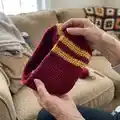
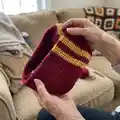
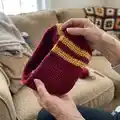
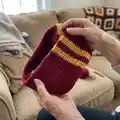
About This Hogwarts House Scarf Pattern
This pattern creates a warm circular Hogwarts House scarf worked in the round with alternating dark and light house stripes. It includes complete instructions for casting on, knitting in the round, changing colors, finishing, blocking, and adding tassel fringe. The design is adaptable to Gryffindor, Slytherin, Ravenclaw and Hufflepuff colorways.
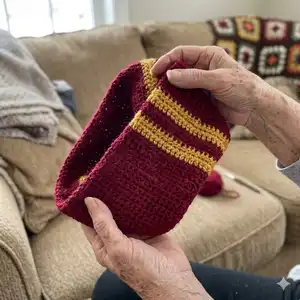
You will work equal amounts of light and dark colored yarn in 22-row stripes to produce a 65-70" scarf. Clear finishing and fringe instructions are included to create a polished finished piece.
Why You'll Love This Hogwarts House Scarf Pattern
I absolutely love this pattern because it combines a classic striped design with simple circular knitting to create a highly wearable statement piece. I love how the 22-row stripes give a bold house identity without complicated colorwork. I enjoy the satisfaction of working in the round for a seamless tube that wears beautifully around the neck. The finishing steps — blocking and precise tassel placement — really elevate the final scarf and make it feel like a thoughtful handmade gift.
Switch Things Up
I love swapping the color pairings to create subtle or bold variations; try cream with navy for a vintage look or charcoal with mustard for a modern palette.
You can make the scarf chunkier by using a bulkier yarn and larger circular needle for a warm, oversized version.
For a super-fine, delicate scarf, choose fingering weight yarn and smaller needles to make a lightweight neck wrap instead.
I often change the stripe length from 22 rows to 14 or 30 rows to make narrower or wider stripes that change the visual rhythm of the scarf.
To create a reversible look, plan the color joins so the tails are woven carefully and the inside is tidy; this makes the tube look great from every angle.
If you want an open scarf instead of a tube, work the same stripe sequence flat on straight needles and seam the long edges or leave it open.
Consider adding embroidered house initials or a small appliqued crest to a single stripe for a personalized touch that stands out.
I sometimes mix yarn textures, using a slight halo or slub for the contrast color to add subtle depth to the stripes.
For travel-friendly minis, use a lighter yarn and smaller needles to make a pocket-sized keychain scarf or a doll accessory using the same stripe logic.
When making tassels, experiment with different numbers of strands or wrapping them with a contrasting thread for a decorative band at the top of each tassel.
Common Mistakes & How to Fix Them
✗ Not slipping the marker before joining the round can twist the work and make the scarf uneven; slip the marker onto the needle before joining to ensure your tube starts untwisted.
✗ Cutting color tails too short when changing colors will make weaving in ends difficult; leave a 2-inch (5.1 cm) tail of contrast color and trim the main color to the same length for easier finishing.
✗ Skipping blocking can cause uneven width and wavy edges after finishing; block the scarf by stretching it width-wise until the entire thing is the same width for a polished look.
✗ Adding tassels without measuring can make uneven fringe lengths at the ends; use a 7.5 inch (19 cm) template like a book or cardboard to measure and cut consistent fringe pieces.
✗ Failing to align color changes on the same side fold can make stripes look mismatched; when drying and folding, align all color changes along one side fold so stripes are less noticeable.