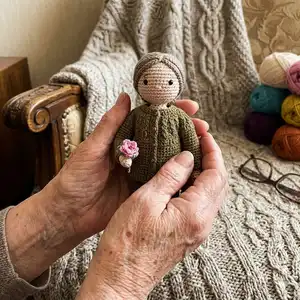
This elegant ladies' cardigan is worked top-down with a circular yoke featuring an intricate cable lace pattern that flows into a smooth stockinette body. The pattern includes multiple sizes, detailed charts for the yoke and button bands, and step-by-step instructions so you can knit a fitted A-line cardigan with a feminine silhouette. You'll enjoy the rich texture of the yarn and the clean ribbed button band finished with small buttons.
Progress Tracker
0% Complete
— Overview :
Info :
'DRAGOBRAT' ladies' cardigan is worked from the neck down completely seamless. The circular yoke features a cable pattern that seamlessly transitions into the stockinette stitch in which the body of the cardigan is worked. Increases at the sides create the A-line shape of the garment.
— Sizes :
Info :
Sizes: 32 (34, 36, 38) (40, 42, 44) (46, 48, 50) (52, 54, 56) (58, 60, 62) in the indicated order.
— Needles and Materials :
Info :
Plucky Knitter – Traveler Sport (297 m/105 g [325 yds / 3.5 oz]; 65% merino wool, 20% silk, 15% yak). Circular knitting needles 2.5 and 3 mm [US1.5 and US2.5] or other appropriate size to obtain gauge; stitch markers, stitch holder, spare circular, extra cords or a piece of auxiliary yarn, tapestry needle; buttons, about 13 mm [0.5 in] diameter; cable needle.
— Yarn Amounts Table :
Info :
Size and total yarn amount needed: 32 - 400 g [14.1], 34 - 430 g [15.2], 36 - 450 g [15.9], 38 - 470 g [16.6], 40 - 500 g [17.6], 42 - 520 g [18.3], 44 - 550 g [19.4], 46 - 600 g [21.2], 48 - 650 g [23.0], 50 - 700 g [24.8], 52 - 730 g [25.75], 54 - 760 g [26.8], 56 - 790 g [27.7], 58 - 810 g [28.6], 60 - 830 g [29.3], 62 - 850 g [30.0].
— Gauge :
Info :
25 sts and 36 rows/rounds = 10x10 cm [4x4 in], in stockinette stitch, on 3.00 mm [US2.5] needles, after blocking and stretched.
— Stitches and Short Definitions :
Info :
Stockinette stitch (st st) – in back- and forth rows with turning: knit on right side, purl on wrong side. In rounds: knit all stitches in all rounds. Reverse stockinette stitch (rev st st): in back- and forth rows with turning: purl on right side, knit on wrong side. In rounds: purl all stitches in all rounds.
Info :
RLI = right-leaning lifted increase (insert right needle into stitch one row below next stitch and knit this additional stitch, then work next stitch as indicated). LLI = left-leaning lifted increase (insert left needle into stitch two rows below the stitch just worked, lift stitch onto left needle and knit this additional stitch, then work next stitch as indicated). ssk = slip, slip, knit: slip 2 sts individually knit-wise, return them to the left needle and knit them together through the back loop (left-leaning decrease).
— Abbreviations :
Info :
BoR = beginning of the round. cn = cable needle. k2tog = knit 2 stitches together. k = knit. p = purl. p2tog = purl 2 stitches together. pfb = purl the same stitch through front and back (1 increased). RS = right side (outside) of the fabric. ssk = slip 1 st knit-wise, slip another st knit-wise, return them to the left needle and knit them together through the back loop. st(s) = stitch(es). tbl = through the back loop. WS = wrong side (inside) of the fabric.
— Order of Work :
Info :
This pattern contains instructions for the following sizes in the indicated order: 32 (34, 36, 38) (40, 42, 44) (46, 48, 50) (52, 54, 56) (58, 60, 62).
— Begin of work :
Info :
Using 2.5 mm [US1.5] needles and preferred cast-on method, cast on 169 (169; 169; 205) (205; 205; 205) (205; 241; 241) (241; 241; 241) (241; 241; 241) sts.
— Work Set-Up Row (WS) :
Info :
Work 12 sts according to the Set-Up Row in the chart for the buttonhole band on the Right Front, k1, place marker 3, then work according to the Set-Up Row in the Yoke Chart. Work the marked pattern repeat width-wise 4 (4; 4; 5) (5; 5; 5) (6; 6; 6) (6; 6; 6) times, place marker 2, work the marked pattern repeat width-wise 4 (4; 4; 5) (5; 5; 5) (5; 6; 6) (6; 6; 6) times, place marker 1, 12 sts according to the Set-Up Row in the chart for the button band on the Left Front.
— Next RS row (first RS after set-up) :
Info :
Work 12 sts according to the next row of the chart for the button band on the Left Front, slip marker 1 to right needle, work the marked pattern repeat width-wise 4 (4; 4; 5) (5; 5; 5) (6; 6; 6) (6; 6; 6) times, slip marker 2 to right needle, work the marked pattern repeat width-wise 4 (4; 4; 5) (5; 5; 5) (5; 6; 6) (6; 6; 6) times, slip marker 3 to right needle, p1, 12 sts according to the next chart row of the buttonhole band chart on the Right Front.
— Continue Yoke Charts :
Info :
Continue in earlier established pattern. After having worked 10 rows of the Yoke chart, change to 3 mm [US2.5] needles and continue. After all rows of the chart have been completed, continue as follows: Work 12 sts according to the next row of the chart for the button band on the Left Front, slip marker 1 to right needle, work the marked pattern repeat of Chart # 3-1 (6-1; 8-1; 2-1) (4-1; 4-1; 7-1) (7-1; 3-1; 5-1) (7-1; 7-1; 7-1) (8-1; 8-1; 8-1) width-wise and so on as directed in the pattern charts and text, ending with the sts after the pattern repeat framed in Red, slip marker 3 to right needle, 12 sts according to the next chart row of the buttonhole band chart on the Right Front.
— Completing Yoke and Redistribute Stitches :
Info :
Continue in established pattern to the end of the appropriate chart for the size worked. Then work in the following manner to complete all rows of the appropriate Yoke chart for the size worked. You should now have a total of 296 (320; 344; 354) (374; 374; 404) (404; 432; 456) (480; 480; 480) (504; 504; 504) sts depending on size.
— Button Band and Buttonhole Band Work :
Info :
Continue in earlier established pattern, working the button band and buttonhole band in the established pattern, and 1 purl stitch each before and after marker 2. Work a RS row in the earlier established pattern. In the next WS row, re-distribute sts, placing markers as follows per size distribution below.
— Sizes redistribution and markers (per size) :
Size 32 :
12 Right Front (buttonhole) Band sts, slip marker 3 to right needle, 42 sts in established pattern, place marker M4 (Right Front), p52, place marker M3 (Right Sleeve), 84 sts in established pattern, place marker M2 (Back), p52, place marker M1 (Left Sleeve), 42 sts in established pattern (Left Front), slip marker 1 to right needle, 12 Left Front (button) Band sts.
Size 34 :
12 Right Front (buttonhole) Band sts, slip marker 3 to right needle, 44 sts in established pattern, place marker M4 (Right Front), p60, place marker M3 (Right Sleeve), 88 sts in established pattern, place marker M2 (Back), p60, place marker M1 (Left Sleeve), 44 sts in established pattern (Left Front), slip marker 1 to right needle, 12 Left Front (button) Band sts.
Size 36 :
12 Right Front (buttonhole) Band sts, slip marker 3 to right needle, 48 sts in established pattern, place marker M4 (Right Front), p66, place marker M3 (Right Sleeve), 92 sts in established pattern, place marker M2 (Back), p66, place marker M1 (Left Sleeve), 48 sts in established pattern (Left Front), slip marker 1 to right needle, 12 Left Front (button) Band sts.
Size 38 :
12 Right Front (buttonhole) Band sts, slip marker 3 to right needle, 47 sts in established pattern (Left Sleeve), 47 sts in established pattern (Left Front), slip marker 1 to right needle, 12 Left Front (button) Band sts.
Size 40 :
12 Right Front (buttonhole) Band sts, slip marker 3 to right needle, 50 sts in established pattern, place marker M4 (Right Front), p76, place marker M3 (Right Sleeve), 98 sts in established pattern, place marker M2 (Back), p76, place marker M1 (Left Sleeve), 50 sts in established pattern (Left Front), slip marker 1 to right needle, 12 Left Front (button) Band sts.
Size 42 :
12 Right Front (buttonhole) Band sts, slip marker 3 to right needle, 50 sts in established pattern, place marker M4 (Right Front), p77, place marker M3 (Right Sleeve), 96 sts in established pattern, place marker M2 (Back), p77, place marker M1 (Left Sleeve), 50 sts in established pattern (Left Front), slip marker 1 to right needle, 12 Left Front (button) Band sts.
Size 44 :
12 Right Front (buttonhole) Band sts, slip marker 3 to right needle, 54 sts in established pattern, place marker M4 (Right Front), p83, place marker M3 (Right Sleeve), 106 sts in established pattern, place marker M2 (Back), p83, place marker M1 (Left Sleeve), 54 sts in established pattern (Left Front), slip marker 1 to right needle, 12 Left Front (button) Band sts.
Size 46 :
12 Right Front (buttonhole) Band sts, slip marker 3 to right needle, 54 sts in established pattern, place marker M4 (Right Front), p83, place marker M3 (Right Sleeve), 106 sts in established pattern, place marker M2 (Back), p83, place marker M1 (Left Sleeve), 54 sts in established pattern (Left Front), slip marker 1 to right needle, 12 Left Front (button) Band sts.
Size 48 :
12 Right Front (buttonhole) Band sts, slip marker 3 to right needle, 60 sts in established pattern, place marker M4 (Right Front), p86, place marker M3 (Right Sleeve), 116 sts in established pattern, place marker M2 (Back), p86, place marker M1 (Left Sleeve), 60 sts in established pattern (Left Front), slip marker 1 to right needle, 12 Left Front (button) Band sts.
Size 50 :
12 Right Front (buttonhole) Band sts, slip marker 3 to right needle, 63 sts in established pattern, place marker M4 (Right Front), p92, place marker M3 (Right Sleeve), 122 sts in established pattern, place marker M2 (Back), p92, place marker M1 (Left Sleeve), 63 sts in established pattern (Left Front), slip marker 1 to right needle, 12 Left Front (button) Band sts.
Size 52 :
12 Right Front (buttonhole) Band sts, slip marker 3 to right needle, 66 sts in established pattern, place marker M4 (Right Front), p99, place marker M3 (Right Sleeve), 126 sts in established pattern, place marker M2 (Back), p99, place marker M1 (Left Sleeve), 66 sts in established pattern (Left Front), slip marker 1 to right needle, 12 Left Front (button) Band sts.
Size 54 :
12 Right Front (buttonhole) Band sts, slip marker 3 to right needle, 66 sts in established pattern, place marker M4 (Right Front), p99, place marker M3 (Right Sleeve), 126 sts in established pattern, place marker M2 (Back), p99, place marker M1 (Left Sleeve), 66 sts in established pattern (Left Front), slip marker 1 to right needle, 12 Left Front (button) Band sts.
Size 56 :
12 Right Front (buttonhole) Band sts, slip marker 3 to right needle, 66 sts in established pattern, place marker M4 (Right Front), p99, place marker M3 (Right Sleeve), 126 sts in established pattern, place marker M2 (Back), p99, place marker M1 (Left Sleeve), 66 sts in established pattern (Left Front), slip marker 1 to right needle, 12 Left Front (button) Band sts.
Size 58 :
12 Right Front (buttonhole) Band sts, slip marker 3 to right needle, 72 sts in established pattern, place marker M4 (Right Front), p99, place marker M3 (Right Sleeve), 138 sts in established pattern, place marker M2 (Back), p99, place marker M1 (Left Sleeve), 72 sts in established pattern (Left Front), slip marker 1 to right needle, 12 Left Front (button) Band sts.
Size 60 :
12 Right Front (buttonhole) Band sts, slip marker 3 to right needle, 72 sts in established pattern, place marker M4 (Right Front), p99, place marker M3 (Right Sleeve), 138 sts in established pattern, place marker M2 (Back), p99, place marker M1 (Left Sleeve), 72 sts in established pattern (Left Front), slip marker 1 to right needle, 12 Left Front (button) Band sts.
Size 62 :
12 Right Front (buttonhole) Band sts, slip marker 3 to right needle, 73 sts in established pattern, place marker M4 (Right Front), p98, place marker M3 (Right Sleeve), 138 sts in established pattern, place marker M2 (Back), p98, place marker M1 (Left Sleeve), 73 sts in established pattern (Left Front), slip marker 1 to right needle, 12 Left Front (button) Band sts.
— Short Rows to Raise Back Neck :
Next Row (RS) :
Work in earlier established pattern to marker M3, slip marker M3 to right needle, k26 (30; 33; 36) (38; 39; 42) (42; 43; 46) (50; 50; 50) (52; 52; 52), turn work to wrong side, slip 1 stitch purl-wise to right needle, leading the working yarn in back of the stitch, above the right needle. Tighten the working yarn so that the stitch on the right needle sits on the needle with two legs visible (Double stitch). Continue working on the wrong side of the fabric in purl. Work to marker M2, slip marker M2 to right needle, p26 (30; 33; 36) (38; 39; 42) (42; 43; 46) (50; 50; 50) (52; 52; 52), turn work to right side. Slip 1 stitch knit-wise to right needle, leading the working yarn in back of the stitch, above the right needle. Tighten the working yarn so that the stitch on the right needle sits on the needle with two legs visible (Double stitch). Continue working on the right side of the fabric.
Next Row 1 :
Work to 5 sts before the Double stitch, turn work to wrong side, slip 1 stitch purl-wise to right needle, leading the working yarn in back of the stitch, above the right needle. Tighten the working yarn so that the stitch on the right needle sits on the needle with two legs visible (Double stitch). Continue working on the wrong side of the fabric in purl.
Row 2 :
Work to 5 sts before the Double stitch, turn work to right side. Slip 1 stitch knit-wise to right needle, leading the working yarn in back of the stitch, above the right needle. Tighten the working yarn so that the stitch on the right needle sits on the needle with two legs visible (Double stitch). Continue working on the right side of the fabric. Repeat Rows 1 and 2 another 2 (2; 2; 2) (2; 2; 3) (3; 3; 3) (3; 3; 3) (3; 3; 3) times as instructed for your size.
Next Row 3 :
Work to 3 sts before the Double stitch, turn work to wrong side, slip 1 stitch purl-wise to right needle, leading the working yarn in back of the stitch, above the right needle. Tighten the working yarn so that the stitch on the right needle sits on the needle with two legs visible (Double stitch). Continue working on the wrong side of the fabric in purl.
Row 4 :
Work to 3 sts before the Double stitch, turn work to right side. Slip 1 stitch knit-wise to right needle, leading the working yarn in back of the stitch, above the right needle. Tighten the working yarn so that the stitch on the right needle sits on the needle with two legs visible (Double stitch). Continue working on the right side of the fabric. Repeat Rows 3 and 4 another 2 (2; 2; 2) (2; 2; 3) (3; 3; 3) (3; 3; 3) (3; 3; 3) times as instructed.
Next Row 5 :
Work to 2 sts before the Double stitch, turn work to wrong side, slip 1 stitch purl-wise to right needle, leading the working yarn in back of the stitch, above the right needle. Tighten the working yarn so that the stitch on the right needle sits on the needle with two legs visible (Double stitch). Continue working on the wrong side of the fabric in purl.
Row 6 :
Work to 2 sts before the Double stitch, turn work to right side. Slip 1 stitch knit-wise to right needle, leading the working yarn in back of the stitch, above the right needle. Tighten the working yarn so that the stitch on the right needle sits on the needle with two legs visible (Double stitch). Continue working on the right side of the fabric. Repeat Rows 5 and 6 another 1 (1; 1; 1) (1; 1; 2) (2; 2; 2) (2; 2; 2) times as instructed for your size.
— After Short Rows and Finishing Yoke :
Info :
Continue in earlier established pattern to end of row, knitting both legs of the Double stitch together as one. Work the next WS row in earlier established pattern, purling both legs of the Double stitch together as one. Continue in earlier established pattern, working the Left Front Band and the Buttonhole Band on the Right Front, and between them, stockinette stitch, until the yoke has reached a height of 19 (19; 19; 19.5) (19.5; 20; 20) (20.5; 20.5; 21) (22.5; 23; 23.5) (23.5; 23.5; 24.0) cm [7.5 (7.5; 7.5; 7.7) (7.7; 7.9; 7.9) (8.1; 8.1; 8.3) (8.9; 9.1; 9.3) (9.3; 9.3; 9.45 in)] measured on the Front, then proceed with Sleeve division.
— Next Row – Sleeve division (RS) :
Next Row – Sleeve division (RS) :
Work 12 Left Front (button) Band sts, slip marker 1 to right needle, work in earlier established pattern to marker M1, slip marker M1 to right needle, transfer the next 52 (60; 66; 72) (76; 77; 83) (83; 85; 92) (99; 99; 99) (99; 99; 98) sts (Left Sleeve) to a stitch holder, piece of waste yarn or spare cord for holding, cast on 16 (16; 18; 22) (24; 28; 28) (32; 32; 32) (32; 34; 38) (38; 44; 46) sts, slip marker M2 to right needle, work in earlier established pattern to marker 2, slip marker 2 to right needle, work in earlier established pattern to marker M3, slip marker M3 to right needle, transfer the next 52 (60; 66; 72) (76; 77; 83) (83; 85; 92) (99; 99; 99) (99; 99; 98) sts (Right Sleeve) to a stitch holder, piece of waste yarn or spare cord for holding, cast on 16 (16; 18; 22) (24; 28; 28) (32; 32; 32) (32; 34; 38) (38; 44; 46) new underarm sts, slip marker M4 to right needle, work in earlier established pattern to marker 3, slip marker 3 to right needle, work 12 Right Front (buttonhole) Band sts.
Info :
After having divided for the sleeves, you should have 224 (232; 248; 254) (270; 276; 294) (302; 324; 336) (346; 350; 358) (382; 394; 400) sts depending on size.
— Continue over Body sts only :
Info :
Move markers M1 and M3 – 2 (2; 3; 5) (6; 8; 8) (10; 10; 10) (10; 11; 13) (13; 16; 17) sts to the left; markers M2 and M4 –2 (2; 3; 5) (6; 8; 8) (10; 10; 10) (10; 11; 13) (13; 16; 17) sts to the right. This way, between markers M1, M3 and M2, M4, 12 sts each have been marked for the side panels, which are worked as: 5 sts in stockinette stitch, 2 sts in reverse stockinette, 5 sts in stockinette stitch.
Info :
Work 2 cm [0.8 in] in earlier established pattern.
— Next Row – increases :
Next Row – increases :
Work in earlier established pattern to 1 st before marker M1, RLI, k1, slip marker M1 to right needle, work the 12 sts of the side panel in pattern described above, slip marker M2 to right needle, k1, LLI, work in earlier established pattern to 1 st before marker M3, RLI, k1, slip marker M3 to right needle, work side panel in pattern described above, slip marker M4 to right needle, k1, LLI, work in earlier established pattern to end of row = 4 sts increased.
Info :
Repeat increases in every 14th (14th; 14th; 14th) (12th; 12th; 12th) (12th; 10th; 10th) (10th; 10th; 10th) (10th; 10th; 10th) row another 5 (5; 6; 8) (8; 11; 11) (12; 12; 10) (11; 12; 13) (12; 13; 15) times as specified for your size.
— Buttonhole band on the Right Front :
Info :
Chart and written Set-Up Row: p3, k6, p2, k1. Rows 1, 5, 7, 9, 11, 13, 15, 17, 19, 21, 23, 25, 27: p1, k2, p1, k4, p1, k3. Rows 2, 6, 8, 10, 12, 14, 16, 18, 20, 22, 24, 26, 28: p3, k6, p2, k1. Row 3: p1, k2, p1, ssk, yo, yo, k2tog, p1, k3. Row 4: p3, k3, k1-tbl, k2, p2, k1. Work Rows 1–28 once, then repeat Rows 3–28 as often as needed, then work Rows 1–2.
— Button band on the Left Front :
Set-Up Row :
k1, p2, k6, p3. Row 1: k3, p1, k4, p1, k2, p1. Row 2: k1, p2, k6, p3. Repeat Rows 1–2.
— Yoke pattern charts and chart rows (overview) :
Info :
Yoke pattern chart #1 rows are provided with chart graphic and written rows. Example rows: Rows 1, 3, 5 (RS): (p1, k2) 6 times. Rows 2, 4, 6 (WS): (p2, k1) 6 times. Row 7: p1, k2, pfb, (k2, p1) 3 times, k2, pfb, k2. Row 8: p2, k2, p2, (k1, p2) 3 times, k2, p2, k1. Row 9: p1, k2, p2, k2, pfb, k2, p1, k2, pfb, k2, p2, k2. Row 10: (p2, k2) 2 times, p2, k1, (p2, k2) 2 times, p2, k1. Row 11: p1, k2, p2, k2, pfb, p1, (k2, p1) 2 times, pfb, k2, p2, k2. Row 12: p2, k2, p2, k1, p1, k1, (p2, k1) 2 times, p1, k1, p2, k2, p2, k1. Row 13: p1, k2, p2, k2, p1, RLI, k1, p1, (k2, p1) 2 times, k1, LLI, p1, k2, p2, k2. Row 14: p2, k2, (p2, k1), work 6 times, k1, p2, k1.
— Yoke pattern charts #2 and #3 (overview) :
Info :
Charts #2-1, #2-2, #2-3, #2-4 and #3-1 include multiple rows and cable transfers, with many written rows included across pages and are to be followed exactly as charted. Example extracted rows from charts: Row 15 (RS): p1, k2, p2, (k2, p1) 6 times, p1, k2, p1, k2, LLI. Rows 16, 18, 20, 22, 24, 26 (WS): k1, p2, k1, (k1, p2) 6 times, k2, p2, k1. Rows 17, 21, 25: p1, k2, p2, (k2, p1) 6 times, p1, k2, p1. Row 19: p1, k2, p2, hold 3 sts on cn BEHIND work, k2, then “p1, k2” from cable needle, (p1, k2) 2 times, p1, hold 2 sts on cn in FRONT of work, k2, p1, then k2 from cable needle, p2, k2, p1.
— Continue body and length instructions :
Info :
You should now have a total of 248 (256; 276; 290) (306; 324; 342) (354; 376; 380) (394; 402; 414) (434; 450; 464) sts. Continue in earlier established pattern until piece has either reached a height of 44 (46; 48; 52) (52; 54; 56) (60; 60; 62) (64; 64; 64) (66; 66; 66) cm [17.3 (18.15; 18.9; 20.5) (20.5; 21.0; 22.0) (23.6; 23.6; 24.4) (25.2; 25.2; 25.2) (26.0; 26.0; 26.0) in] or is 10 cm [5 in] shorter as desired length from sleeve division.
— Side panel and ribbing before binding off :
Info :
In the next RS row, work in earlier established pattern to marker M1, then work the side panel sts as “k1, p2, k2, p2, k2, p2, k1” (= 12 sts), slip marker M2 to right needle, work in earlier established pattern to marker M3, then work the side panel sts as “k1, p2, k2, p2, k2, p2, k1” (= 12 sts), slip marker M4 to right needle, work in earlier established pattern to end of row. Work 3 more rows (1 RS, 1 WS, 1 RS) in earlier established pattern.
— Ribbing and bind off :
Info :
In the next RS row, change to 2.5 mm [US1.5] needles and begin working ribbing as follows: Work 12 Left Front (button) Band sts, slip marker 1 to right needle, p1, work in “k2, p2” ribbing to 3 sts before marker 2, k2, p1, slip marker 2 to right needle, p1, k2, work in “p2, k2” ribbing to 1 st before marker 3, p1, slip marker 3 to right needle, work 12 Right Front (buttonhole) Band sts. Work the buttonhole and button band and between them, “k2, p2” ribbing for 10 cm [4 in], then bind off all sts.
— Right Sleeve :
Info :
Take up the formerly held sts again, and place them on a 3.0 mm [US2.5] circular needle. Right side facing, join new working yarn, place BoR marker, work 16 (16; 18; 22) (24; 28; 28) (32; 32; 32) (32; 34; 38) (38; 44; 46) sts into the corresponding sts at the side of the cardigan as they appear: knit the knit sts and purl the purl sts, place marker 1, work in stockinette stitch to end of row, join to work in the round. You should now have a total of 68 (76; 84; 94) (100; 105; 111) (115; 118; 124) (131; 133; 137) (137; 143; 144) sts as appropriate by size.
Info :
Work the sleeve in stockinette stitch in the round, purling the 2 sts in the center between BoR marker and marker 1. Work even over an unchanged stitch count until sleeve has either reached a length of 45 (45; 46; 47) (48; 50; 50) (52; 53; 54) (54; 55; 56) (56; 58; 59) cm [17.7 (17.7; 18.1; 18.5) (18.9; 19.7; 19.7) (20.5; 20.9; 21.25) (21.25; 21.65; 22) (22; 22.8; 23.2) in] from armhole, or is 10 cm [4 in] shorter than desired sleeve length.
— Sleeve ribbing and bind off :
Info :
Change to 2.5 mm [US1.5] needles, and proceed with working “k2, p2” ribbing, in the first round decreasing 0 (0; 0; 2) (0; 1; 3) (3; 2; 0) (3; 1; 1) (1; 3; 0) st(s) evenly distributed, by working p2tog (once if the number for your size is “1”, twice if your number is “2”, and not at all if your number is “0”) as required. You should now have a total of – 68 (76; 84; 92) (100; 104; 108) (112; 116; 124) (128; 132; 136) (136; 140; 144) sts depending on size. After having worked 10.0 cm [4.0 in] in ribbing, bind off all sts. Work the Left Sleeve the same way.
— Finishing :
Info :
Moisten the cardigan, and block on an even horizontal surface, leaving pinned until completely dry. Sew the buttons to the Left Front Band in the appropriate spots. Hide all ends. Happy knitting! ☺
This beautifully textured cardigan balances lace cables and smooth stockinette for an elegant everyday knit. It is thoughtfully sized and charted for a wide range of sizes, with a neat button band and precise short-row shaping for the neck. Make one for yourself or as a cherished handmade gift — it's a true wardrobe classic. 🧶✨