🧢 Beautiful ✨ Detailed πŸ’ Adorable

Budgerigar Amigurumi Pattern

Budgerigar Amigurumi Pattern
4.7β˜… Rating
5-7 Hours Time Needed
2.5K Made This
βœ‚οΈ

Intermediate Level

Ideal for those with basic crochet experience, featuring slightly more advanced stitches and techniques to expand your skills.

⏱️

Weekend Treat

Takes 5-7 hours, making it an enjoyable project to finish over a couple of days.

🧸

Cute Companion

An adorable friend to cherish, handcrafted with love to bring comfort and joy for years to come.

About This Budgerigar Amigurumi Pattern

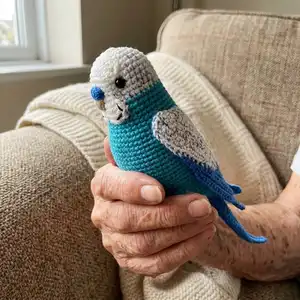
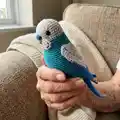
This pattern creates a realistic miniature budgerigar (budgie) with wired legs and tail for shaping, finely detailed wings and feather elements, and a stitched face. It uses YarnArt Etamin (fine acrylic) and a very small steel hook to achieve neat stitches and delicate detail. The design includes full round-by-round instructions, wire framing tips, and a cheat sheet for closing rounds invisibly.

Budgerigar Amigurumi Pattern crochet pattern - detailed view of completed project

You will learn how to build a small wire frame for the legs and tail, crochet feather elements with a wire core, and assemble the parts for a lifelike pose. Clear photographs and step instructions are included to guide your assembly and finishing choices.

Why You'll Love This Budgerigar Amigurumi Pattern

I absolutely love this pattern because it combines delicate crochet with simple wirework to create a wonderfully posed little bird that feels alive. I enjoy how the fine yarn and small hook produce crisp stitches and tiny details that really show in the finished budgerigar. The feather construction and wired tail allow for creative shaping β€” I often tweak the tail angle to give each bird a unique attitude. Working this pattern relaxes me: it is methodical but rewarding, and I always smile when the assembly brings the character together.

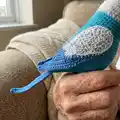
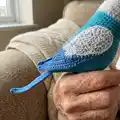
Budgerigar Amigurumi Pattern step 1 - construction progress Budgerigar Amigurumi Pattern step 2 - assembly progress Budgerigar Amigurumi Pattern step 3 - details and accessories Budgerigar Amigurumi Pattern step 4 - final assembly and finishing

Switch Things Up

I love customizing this budgerigar by changing the color scheme; try pastel shades for a soft decorative bird or bright, saturated colors for a playful look.

I often adjust the size by switching yarn weight and hook size β€” bulky yarn and a larger hook make a chunky, cuddly version while very fine thread and a tiny hook produce a delicate miniature.

You can alter the wing shape or feather count to make different poses: longer feathers for an elegant tail or shorter ones for a rounder silhouette.

I sometimes add embroidered markings on the forehead and cheeks for extra character; small beads or sequins work great for cheek spots if you prefer a shiny detail.

Consider making the legs removable (sewn with a button joint) if you want to swap poses or store the toy flat for travel.

Try adding tiny accessories like a crocheted scarf, hat, or a perch wrap to create a whole scene or gift set; these small touches make the budgie extra charming.

If you want a more child-safe toy, skip bead eyes and embroider the eyes instead; secure all wires well inside and pad wire ends thoroughly.

I also experiment with different wire gauges: thinner wire for feather frames and slightly thicker for the leg frames gives the best balance of shape and durability.

For a themed set, make a family of budgies in complementary colors and different sizes by using the same stitch counts but varying yarn/hook combinations.

Finally, I recommend trying small stitched variations in the beak or cere color to indicate gender (blue cere for boys, beige/brown for girls) and create lifelike pairs.

Common Mistakes & How to Fix Them

βœ— Skipping the instruction to keep the magic ring loose can cause a closed hole in the toes or feet; leave the ring open as instructed so you can insert the wire and close invisibly. βœ— Not adding stuffing as you crochet the body leads to lumps or gaps; stuff gradually and check shaping often to maintain a smooth silhouette. βœ— Failing to protect wire ends will risk poking through the toy; isolate and wrap wire ends with textile band-aid or tape before inserting into the body. βœ— Using a hook that is too large with Etamin yarn creates loose stitches and visible holes; use the recommended 1.25 mm steel hook to keep stitches tight and tidy. βœ— Forgetting to move the marking thread when crocheting loop offset causes the figure to curve unevenly; follow the LO guidance and move the marker 1-2 sc to the left when needed.

Budgerigar Amigurumi Pattern

Make an adorable hand-crocheted budgerigar amigurumi using fine threads, a tiny hook and simple shaping techniques. This pattern guides you through wire-framed legs and tail, detailed wing and feather construction, and step-by-step assembly so you can create a realistic little parrot. Suitable for crocheters who enjoy careful, detailed work and a charming finished toy.

Intermediate 5-7 Hours

Materials Needed for Budgerigar Amigurumi Pattern

β€” Main Fabric

  • 01
    YarnArt Etamin 100% Acrylic, 180 m / 30 g (196 yds in 1.06 oz) - colors suggested: light blue-425, blue-462, beige-448, white-421, grey-449 for blue budgerigar
  • 02
    YarnArt Etamin 100% Acrylic - yellow-461, green-438, blue-462, beige-448 for green budgerigar
  • 03
    Consumption estimate: main color approximately 6 g, additional colors about 3 g each, plus small amounts for details
  • 04
    Small leftover yarn for filling/padding details and beak filling

β€” Tools Required

  • 01
    Steel crochet hook size 1.25 mm (#8 US) for Etamin
  • 02
    Fine navy blue or dark olive thin bobbin thread to add to yarn
  • 03
    Fiberfill (polyester stuffing)
  • 04
    Wooden skewer or toothpick with a broken tip for stuffing
  • 05
    Tapestry needle
  • 06
    Scissors
  • 07
    Round pliers and wire cutters
  • 08
    Wire for needlework: steel wire 0.5 mm diameter or copper wire 1 mm thick for feet and 0.5 mm bead wire for feather frames
  • 09
    Textile band-aid to isolate wire ends
  • 10
    5 mm black half round beads - 2 pcs (or alternatives for eyes)
  • 11
    Moment Crystal Glue and PVA glue
  • 12
    Sequins or beads for spots (2 mm diameter - 6 pcs) and thread for tightening the tail
  • 13
    Stitch markers

Progress Tracker

0% Complete

β€” Leg - make two :

Info :

We make leg with toes on a wire frame. Cut 4 pieces of wire 8 cm (3 inch) long. On the tip of the wire, wind the yarn in a single layer 16 mm (0,6 inch) long, moisten it with PVA glue and fix the tip with a clip. Let it dry.

Info :

We don't cut the thread from the fourth toe. Put your toes together and continue to wrap, forming a leg. The winding length is 3 cm (1,2 inch). It can also be impregnated with PVA glue.

Info :

We make the limiter with a pair of turns with a textile band-aid at a height of 2 cm (0,8 inch) from the toes. The leg is ready. Repeat for the second leg.

Round 1 :

6 sc in MC, we close the ring, but do not tighten it! We direct the tail from the ring inward, but do not crochet or shorten.

Round 2-3 :

6 sc

Round 4 :

(inc, 2 sc) * 2 = 8, to close the work invisibly without skipping the loop = 9 (cheat sheet)

Info :

Insert the wire foot into the amigurumi circle, but do not tighten it. Put the foot aside. Crochet the second same foot.

β€” Head-body :

Info :

We start crocheting with white yarn with the addition of dark blue thin bobbin thread or yellow yarn with the addition of dark olive bobbin thread. The legs will be involved in the process of making the body, so we will do them first.

Round 1 :

ch 5, 3 sc, inc, 3 sc on the other side of the chain = 8

Round 2 :

(inc, 2 sc, inc) * 2 = 12

Round 3 :

(sc, inc) * 6 = 18

Round 4 :

(2 sc, inc) * 6 = 24

Round 5 :

(3 sc, inc) * 6 = 30

Round 6-8 :

30 sc

Round 9 :

(inc, 14 sc) * 2 = 32 + LO

Round 10 :

32 sc

Info :

Change the thread to green / blue.

Round 11 :

inc, 31 sc = 33

Round 12 :

inc, 32 sc = 34

Round 13 :

(inc, 16 sc) * 2 = 36 + LO

Round 14 :

(inc, 17 sc) * 2 = 38

Round 15 :

inc, 18 sc, inc, 17 sc, inc = 41

Round 16 :

(inc, 19 sc) * 2, inc = 44

Round 17 :

44 sc

Round 18 :

inc, 42 sc, inc = 46 + LO

Round 19-21 :

46 sc

Round 22 :

inc, 44 sc, inc = 48

Round 23-27 :

48 sc + LO

Round 28 :

dec, 46 sc = 47

Round 29 :

dec, 45 sc = 46

Round 30 :

dec, 44 sc = 45

Round 31 :

dec, 41 sc, dec = 43

Round 32 :

3 sc, dec, 33 sc, dec, 3 sc = 41

Round 33 :

7 sc, dec, 23 sc, dec, 7 sc = 39

Info :

Partially fill the toy with fiberfill (photo 1). Check that the marking thread runs exactly in the center of the front. It is convenient to fold the figure in half along the initial chain - then the displacement is clearly visible. If necessary, we crochet loops offset.

Round 34 :

dec, sc, 5 join sc with thigh, 2 sc, dec, 15 sc, dec, 2 sc, 5 join sc with thigh, sc, dec = 32 (photo 2-3, scheme). Attention! The number of loops in a row does not match the arithmetic operations, since we crocheted 5 loops per thigh, and left 4 loops each.

Info :

Since the bird's body is partially stuffed and almost finished, we can determine the length of the legs in accordance with the proportions of the resulting figure (it depends heavily on the chosen yarn and knitting density).

Round 35 :

dec, 4 sc on the leg, 20 sc on the body, 4 sc on the leg, dec = 30

Round 36 :

7 sc, dec, 12 sc, dec, 7 sc = 28

Round 37 :

2 sc, dec, 20 sc, dec, 2 sc = 26

Round 38 :

5 sc, dec, 12 sc, dec, 5 sc = 24

Round 39 :

3 sc, dec, 14 sc, dec, 3 sc = 22

Round 40 :

sc, dec, 16 sc, dec, sc = 20

Round 41 :

sc, dec, sc, dec, 8 sc, dec, sc, dec, sc = 16

Info :

Fill the body with fiberfill. Twist the frame wires together, isolate the ends with a textile band-aid. Insert the frame into the bird's body. Carefully place the fiberfill so that the frame is not palpable. Press the legs to the chest so that they do not interfere with continuing crocheting.

Round 42 :

thru.dec, dec, 8 sc, dec, thru.dec = 12

Round 43 :

thru.dec, dec, 4 sc, dec, thru.dec = 8, fasten off, leaving a long thread for sewing the tail.

Info :

Fill the body with fiberfill finally. Bend the legs to a natural position. Bend toes - 2 forward and 2 back. Give the toes a curved shape with round pliers (photo 1). Trim and file nails to prevent scratching.

β€” Wings :

Info :

Crochet yellow/white yarn with the addition of olive/dark blue fine bobbin thread. Crochet two wings (make the second the same, do not mirror).

Round 1 :

ch 6, inc, 3 sc, 3 sc in 1, 4 sc, sl st, ch, turn = 12 (photo 2)

Round 2 :

inc, 5 sc, inc, ch, turn = 9

Round 3 :

inc, 7 sc, inc, ch, turn = 11

Round 4 :

inc, 4 sc, 2 hdc, inc hdc, 2 dc, inc dc, turn = 14 (photo 3)

Round 5 :

inc dc, 2 dc, inc hdc, 2 hdc, 7 sc, 3 sc in 1, 11 sc, 2 sc, 2 sc, continue crocheting in the same direction.

Round 6 :

inc dc, 2 dc, inc hdc, 7 hdc, inc hdc, 3 hdc, sc, sl st, fasten off (photo 4). Cut the thread, leaving a tail for sewing. Crochet the second same wing.

β€” Feathers :

Info :

Wing feathers should be carefully starched or crocheted with carcass wire. Prefer to use 0.5 mm thick copper wire in the yarn winding. The coils should cover the wire in one layer only. Attach the green/blue yarn to the sharp corner of the wing along the long side. The feather attaches to the wing at the end of the feather attaching it to the wing - we consider the wing to be the basis of crocheting.

Feather 1 :

ch 3, add wrapped wire, sc in the bend of the wire, 3 sc, sc in the same loop where the chain began, 2 sc on the base, turn.

Feather 2 :

skip 2, 3 sc, ch 3, sc in the band of the wire, 6 sc, sc in the same loop where the feather began, sc on the base, turn. Then: 2 sc in the band of the wire, then crochet FLO: 15 sc, sc in the wire, turn, 15 sc, for both edges of the loop: inc.

Feather 3 :

skip 1, 7 sc, ch 3, sc in the band of the wire, 10 sc, sc in the same loop where the feather began, 5 sc on the base, turn. Then: inc, crochet FLO: 15 sc, sc in the wire, turn, 15 sc, sc, sl st. Fasten the thread, hide the end of the thread inside the single crochets.

Feather 4 :

skip 1, 15 sc, 6 ch, sc in the band of the wire, 21 sc, sc in the same loop where the feather began, 3 sc on the base, sl st, to close the work invisibly without skipping the loop. Repeat for the second wing the same way, without mirroring anything.

β€” Tail :

Info :

I also lay a frame wire with a winding in the tail so that I do not have to starch. Bend the base of the tail with a corner, insert the tail into the remaining hole on the body. Sew on the tail with the end of the yarn left on the body.

Tail Feather 1 :

ch 25, 23 sc (photo 1-2), 3 sc in 1, 23 sc.

Info :

Bend the base of the tail with a corner, insert the tail into the remaining hole on the body. Sew on the tail with the end of the yarn left on the body.

β€” Forehead & cheeks :

Info :

Crochet yellow/white yarn in one thread for forehead & cheeks pieces.

Round 1 :

ch 6, 5 sc, ch, turn = 5

Round 2 :

inc, 3 sc, inc, ch, turn = 7

Round 3 :

inc, 5 sc, inc, ch, turn = 9

Round 4-5 :

9 sc, ch, turn

Round 6 :

dec, 5 sc, dec, ch, turn = 7

Round 7 :

dec, 3 sc, dec, ch, turn = 5

Round 8 :

dec, sc, dec = 3

Info :

Crochet in a circle with sc, make increase so that the muzzle will be smooth, sl st, ch (photo 1).

Round 9 :

3 sc, ch, turn = 3

Round 10 :

inc, sc, inc, ch, turn = 5

Round 11 :

(dc, 5 htr, dc) in 1, 3 sc, (dc, 5 htr, dc), sl st. Fasten off, leaving a long tail for sewing.

β€” Cere :

Info :

Crochet in one thread in blue or brown for the cere. Ch 3, 4 sc in 1, 4 sc in 1, sl st. Cut the thread, leaving the tip for sewing.

β€” Beak :

Info :

We crochet the beak in a spiral around the chain by beige yarn.

Round 1 :

ch 4, 2 sc, inc, 2 sc = 6

Round 2 :

dec, 4 sc = 5

Round 3 :

dec, 3 sc = 4, fill with leftover yarn. Pull the hole by the front loops, leaving a long tail for sewing.

β€” Assembly :

Info :

Assembly and design of the toy: sew forehead behind both edges of the loops so cheeks cover the color change step, sew the beak with invisible stitches, sew the cere on both edges of the loops bending the upper edge so that the holes of the initial chain form the nostrils.

Item (P1) :

Glue the eyes under the forehead; the eyes of the birds are located almost on the sides of the head. Embroider black spots on the cheeks with threads, beads or sequins, and a blue stroke as in the photo. Give toes a slightly curved shape, bend the tips of the claws with round pliers at an angle of 90 degrees, file claws so they do not scratch.

Info :

Take a picture of the toy and share with the author's credit if desired.

Assembly Instructions

  • Sew the forehead behind both edges of the loops. Position the cheeks so they cover the color change step and align the forehead edge to the middle of the head's initial chain.
  • Sew the beak with invisible stitches and sew the cere on both edges of its loops, bending the upper edge so the chain holes form the nostrils.
  • Glue or attach safety eyes under the forehead, placing them slightly to the sides of the head for a natural budgie appearance; add black spots on cheeks with beads or embroidery and a blue mark if desired.
  • Insert the wire frame into the body, place fiberfill so the frame is not palpable, press the legs to the chest so they do not interfere with crocheting, then sew the legs firmly in place.
  • Sew wings and feather elements to the body edges, attach tail into the remaining opening and secure by sewing with the yarn tail left on the body.
  • Bend toes into a natural curved position and shape the nails with round pliers; isolate wire ends with textile band-aid to prevent poking.
  • Pin all parts in place before final sewing to check symmetry and angle; make final adjustments to feather placements and tail pose then fasten off and weave in ends.

Important Notes

  • πŸ’‘Use stitch markers to keep track of the round start, especially when changing colors or using loop offsets.
  • πŸ’‘Stuff gradually while shaping; overstuffing will distort proportions and under-stuffing will leave gaps around the wire frame.
  • πŸ’‘Protect wire ends with a textile band-aid or tape before inserting into the body to prevent the wire from poking through the crochet fabric.
  • πŸ’‘Work in a spiral where indicated and maintain consistent tension to ensure even stitch size and smooth shaping.
  • πŸ’‘Pin parts in place and check symmetry before sewing permanently to avoid misaligned features.

This sweet budgerigar amigurumi pattern includes step-by-step rounds, wire framing tips, and feather techniques to create a lifelike pocket bird. You can make colorful variations using the suggested yarn palette and adjust wire shaping for different poses. Enjoy the slow, detailed process and celebrate the tiny, charming result! πŸ§ΆπŸ•ŠοΈ

You ask,

we answer.

FAQs

What size will the finished piece be?

The finished budgerigar measures approximately 9.5 x 13.5 cm (3.7 x 5.3 inches) depending on yarn and hook size.

Can I use different yarn weights for this pattern?

You can use different yarn weights, but this will affect the final size and appearance; if you change yarn weight, adjust the hook size accordingly and consider substituting wire thickness for structural strength.

Do I need prior crochet experience for this pattern?

This pattern is rated intermediate; basic amigurumi and stitch knowledge are recommended, plus some experience with small hooks and simple wirework for shaping.

How long does this project typically take to complete?

Most crocheters finish this project in 5-7 hours, depending on experience and the time spent on feather and assembly detailing.

How do I make the legs and tail poseable?

The pattern describes using thin steel or copper wire inside the yarn winding for legs and tail; twist the frame wires and isolate the ends with textile band-aid so you can bend and pose the limbs safely.