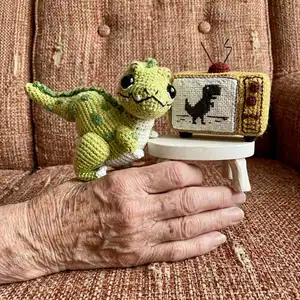
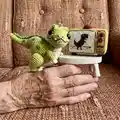
Make your own adorable Tyrannosaurus Oliver with this detailed amigurumi crochet pattern. You will enjoy step-by-step instructions, photos and finishing tips to create a poseable, smiling dino with a retro TV bonus. The pattern uses two yarns and simple shaping techniques so you can personalise color and expression. Perfect as a handmade gift or a keepsake to treasure.
Progress Tracker
0% Complete
— HEAD (Yarn A) :
Round 1 :
7 loops, turning, 6sc (starting from the 2nd loop from the hook), 6sc (from the back of the chain) (12l)
Round 2 :
[sc, inc]x6 (18l)
Round 5 :
[2sc, inc]x6 (24l)
Round 8 :
3sc, [inc]x18, 3sc (42l)
Round 9 :
18sc, 4dc in the next loop, [dec]x4, 4dc in the next loop, 14sc (44l)
Round 10 :
19sc, [2dc in the next loop]x2, sc, 4 sl st, sc, [2dc in the next loop]x2, 15sc (48l)
Round 11-13 :
24sc, 4 sl st, 20sc (48l)
Round 14 :
18sc, [dec]x3, 4sc, [dec]x3, 14sc (42l)
Round 16 :
[5sc, dec]x6 (36l)
Round 17 :
[4sc, dec]x6 (30l)
Round 18 :
[3sc, dec]x6 (24l)
Info :
Insert safety eyes between the rounds 7 and 8, the distance between them is approximately 10 stitches, do not fix yet.
Info :
Using the yarn needle to do from above of the eye "loose stitch" of black thread floss. Separate one thread and fasten with a needle "loose stitch" in the middle of the eye. In the same way, embroider one more "loose stitch" 1 mm higher than the previous one, in order to get an oval shape.
Info :
Using yarn needle to do from below the eye "loose stitch" of white thread floss. Separate one thread and fasten with a needle "loose stitch". Press the eye to the embroidered line and fasten it.
Info :
Divide the black threads floss in half, embroider the nostrils and mouth (see photos 13-21). Embroider 6 teeth (3pcs on each side) with white threads floss (divide in half) in the form of triangles (see photos 22-24).
Round 21 :
[2sc, dec]x6 (18l)
Round 22 :
[sc, dec]x6 (12l)
Info :
Start stuffing the head with synthepus and continue crocheting.
Info :
Trim the thread. Pass the thread through all the loops using a yarn needle. Tighten and secure.
— CREST on the head :
Info :
Crochet crest with a hook 1.5 mm and green mouline threads.
Round 1 :
27 loops, turning, sl st (starting from the 2nd loop from the hook), [sl st; crochet in one loop- {sl st, dc, sl st}; sl st]x8, sl st
Info :
Cut and fix the thread, leaving a very long end for sewing. Sew the crest to the head, pre-fixing it with needles for cutting, in order to achieve perfect symmetry.
— CHEEKS, 2 pcs (Pink threads mouline) :
Round 1 :
2 loops, 6sc in 2nd loop from hook (amigurumi ring), sl st in 1st sc (6l)
Info :
Cut and fix the thread, leaving a long end for sewing. Sew the cheeks to the head with the wrong side outward.
— NECK and BODY :
Round 1 :
Yarn A 1: 2 loops, 8sc in 2nd loop from hook (amigurumi ring) (8l)
Info :
Next, you need to crochet the body of yarn A and yarn B at once, alternately change the thread, but not cutting it to get a white breast. This technique is called jacquard.
Round 3 :
[3sc, inc]x2 (Yarn B); [3sc, inc]x2 (Yarn A) (20l)
Round 4 :
only through back loops 10sc (Yarn B); 10sc (Yarn A) (20l)
Round 5 :
[4sc, inc]x2 (Yarn B); [4sc, inc]x2 (Yarn A) (24l)
Info :
Insert cotter pin in the middle of the neck (see photo 56). Put the disk on cotter pin and wrap the ends in the "rings" with the help of round-nosed pliers.
Round 6 :
12sc, (Yarn B); 6sc, 4 loops, turning, 3sc starting from the 2nd loop from the hook, sl st in the same loop (in which the last sc was crocheted before the chain), 6sc (Yarn A) (30l)
Round 7 :
12sc (Yarn B); 9sc, 4 loops, turning, 3sc starting from the 2nd loop from the hook, sl st in the same loop, 9sc (Yarn A) (36l)
Round 8 :
[5sc, inc]x2 (Yarn B); [5sc, inc]x4 (Yarn A) (42l)
Round 9 :
14sc, (Yarn B); [6sc, inc]x2, 4 loops, turning, 3sc starting from the 2nd loop from the hook, [6sc, inc]x2 (Yarn A) (52l)
Round 10 :
14sc (Yarn B); [7sc, inc]x2, 6sc, [7sc, inc]x2 (Yarn A) (56l)
Round 11 :
14sc (Yarn B); 21sc, 4 loops, turning, 3sc starting from the 2nd loop from the hook, sl st in the same loop, 21sc (Yarn A) (62l)
Round 12 :
14sc (Yarn B); 24sc, 4 loops, turning, 3sc starting from the 2nd loop from the hook, sl st in the same loop, 24sc (Yarn A) (68l)
Info :
It is more convenient to crochet with the jacquard only the front of the body, and the back should only be crocheted from yarn A. At the end of the row, when crocheting the last green sc, insert the hook into the loop, pull out the thread, and crochet this sc to the end with a white thread grabbing it in the place where it remained. A "loose stitch" is formed on the wrong side. You need to move it forward along with the green thread, so when crocheting jacquard it will be inside and the wrong side will become as neat as the front one.
Round 13 (incomplete round) :
14sc (Yarn B); crochet 26sc along the body, crochet 2sc of the body together with 2sc of the tail, then crochet 26sc along the body (Yarn A)
Round 14 :
15sc (Yarn B); crochet 25sc on the body, crochet 18sc on the tail, crochet 26sc on the body (Yarn A) (84l)
Round 15 :
15sc (Yarn B); 19sc, [dec]x3, 18sc, [dec]x3, 20sc (Yarn A) (78l)
Round 16 :
16sc (Yarn B); 15sc, [dec]x3, 18sc, [dec]x3, 17sc (Yarn A) (72l)
Round 17 :
16sc (Yarn B); 12sc, [dec]x3, 18sc, [dec]x3, 14sc (Yarn A) (66l)
Round 18 :
17sc (Yarn B); 14sc, [sc, dec]x6, 17sc (Yarn A) (60l)
Round 19 :
17sc (Yarn B); 14sc, [dec]x6, 17sc (Yarn A) (54l)
Info :
Next cut the yarn A and continue crocheting with yarn B only.
Round 20 :
[7sc, dec]x6 (48l)
Round 21 :
[6sc, dec]x6 (42l)
Round 22 :
[5sc, dec]x6 (36l)
Round 23 :
[4sc, dec]x6 (30l)
Round 24 :
[3sc, dec]x6 (24l)
Round 25 :
[2sc, dec]x6 (18l)
Round 26 :
[sc, dec]x6 (12l)
Info :
Trim the thread. Pass the thread through all the loops using a yarn needle. Tighten and secure. Tip: Cut out a circle of white felt slightly larger than the resulting hole and insert it into the hole to prevent stuffing from clinging to the hook during closing.
— TAIL (Yarn A) :
Round 1 :
2 loops, 4sc in 2nd loop from hook (amigurumi ring) (4l)
Round 2 :
[inc]x2, dec (5l)
Round 3 :
sc, [inc]x2, dec (6l)
Round 4 :
sc, [inc]x2, sc, dec (7l)
Round 5 :
sc, [inc]x3, sc, dec (9l)
Round 6 :
2sc, inc, sc, inc, 2sc, dec (10l)
Round 8 :
3sc, [inc]x3, 2sc, dec (12l)
Round 10 :
3sc, [inc]x5, 2sc, dec (16l)
Round 12 :
dec, 4sc, [inc]x4, 4sc, dec (18l)
Round 14 :
dec, 5sc, [inc]x4, 5sc, dec (20l)
Info :
Cut and fix the thread. Stuff the tail with synthepus. Mark with a pin the place where the tail connects to the back - move the pin to the 12 loop from the beginning of the round clockwise. Connect the body with the tail in the next round.
— LEGS, 2 pcs (Yarn A) :
Round 1 :
9 loops, turning, 8 sl st (starting from the 2nd loop from the hook), 8 sl st (from the back of the chain) (16l)
Round 2 :
[7sc, inc]x2 (18l)
Round 7 :
3sc, dec, 8sc, dec, 3sc (16l)
Round 8 :
3sc, dec, 6sc, dec, 3sc (14l)
Round 9 :
2sc, dec, 6sc, dec, 2sc (12l)
Start stuffing :
Start stuffing the leg with synthepus.
Round 12 :
sc, [dec]x2, 2sc, [dec]x2, sc (8l)
Round 13 :
sc, dec, 2sc, dec, sc (6l)
Info :
Completely fill the leg, don't stuff further.
Round 14 :
6sc only through back loops (6l)
Round 15 :
4sc, [inc]x2 (8l)
Round 16 :
4sc, [inc]x4 (12l)
Round 18 :
7sc, [inc]x4, sc (16l)
Info :
Change the thread to Yarn B (leave the long end of Yarn A). Remove the pin that marking the beginning of the round. Fold the resulting 16 loops in half and in the next round, crochet both halves together.
Round 20 :
1 loop, turning, 8 sl st (8l)
— HANDS, 2 pcs (Yarn A) :
Round 1 :
2 loops, 6sc in 2nd loop from hook (amigurumi ring) (6l)
Round 2 :
[inc, sc]x3 (9l)
Round 4 :
[inc]x3, [dec]x3 (9l)
Round 6 :
[dec]x3, [inc]x3 (9l)
Info :
Stuff the hand with synthepus.
Round 7 :
[sc, dec]x3 (6l)
Info :
Change the thread to Yarn B, cut the Yarn A thread. Remove the pin that marking the beginning of the round. Fold the resulting 6 loops in half and in the next round, crochet both halves together.
Round 8 :
1 loop, turning, 3 sl st (3l)
Round 9 :
1 loop, turning, crochet in 1 loop - {sc, 2 loops, sl st}; sl st; crochet in 1 loop - {sc, 2 loops, sl st} (see photo 99)
— CREST on the body :
Round 1 :
Crochet crest with a hook 1.5 mm and green mouline threads: 45 loops, turning, sl st (starting from the 2nd loop from the hook), [sl st; crochet in one loop - {sl st, dc, sl st}; sl st]x14, sl st
Info :
Cut and fix the thread, leaving a very long end for sewing. Sew the crest to the body, pre-fixing it with needles for cutting, in order to achieve perfect symmetry.
— SPOTS :
SMALL, 8 pcs :
1: 3 loops, turning, 2sc (starting from the 2nd loop from the hook), 2sc (from the back of the chain) sl st in 1st sc (4l). Cut and fix the thread, leaving a long end for sewing.
MIDDLE, 6 pcs :
1: 4 loops, turning, 3sc (starting from the 2nd loop from the hook), 3sc (from the back of the chain) sl st in 1st sc (6l). Cut and fix the thread, leaving a long end for sewing.
BIG, 4 pcs :
1: 5 loops, turning, 4sc (starting from the 2nd loop from the hook), 4sc (from the back of the chain) sl st in 1st sc (8l). Cut and fix the thread, leaving a long end for sewing.
— ASSEMBLY :
Info :
Sew on the spots on the hands, legs, back and tail. Sew your crocheted hands and legs to the body with a threaded bracing (use round-nosed pliers to make it easier to pull the needle). Attach the hands between rounds 9 and 10 of body, distance between hands approx 16 stitches; legs between 17 and 18 rounds of body, distance between legs approx 26 stitches.
Info :
Insert the needle through the back into the hand attachment point (leaving the loose end of the thread outside). Thread the needle through two loops on the inner surface of the hand (the needle for cutting must be in the middle). Insert the needle into the body at the hand attachment point and pull out it at the point of attachment of the second hand. Pass the needle through the second hand in the same way and sew the body and the hands two more times for strength.
Info :
Insert the needle at the hand attachment point and pull out it at the point of attachment of the opposite leg. Thread the needle through the leg, insert the needle into the body at the leg attachment point and pull out it at the point of attachment of the second leg. Pass the needle through the second leg and sew the body and the legs two more times for strength. Insert the needle into the body at the leg attachment point and pull out it at the back in the place, where it was introduced at the very beginning. Tie a few knots and hide the thread.
This Tyrannosaurus Oliver amigurumi pattern is full of personality and small details that make him truly special. Make one for yourself or as a thoughtful handmade gift, and enjoy the playful construction and poseable head. Happy crocheting and have fun bringing Oliver to life! 🧶🦖