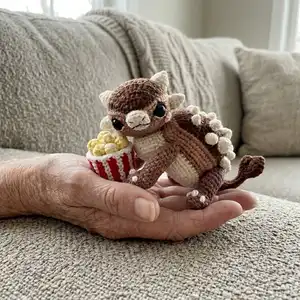
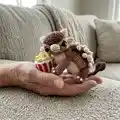
Make your own chubby Ankylosaurus Bruno with this detailed intermediate amigurumi pattern. You will love the playfully textured shell, movable tail option and tiny spikes that give Bruno his character. The pattern provides clear step-by-step rounds, material lists and assembly photos so you can crochet with confidence. Perfect as a gift or a charming shelf friend.
Progress Tracker
0% Complete
— Head :
Round 1 :
Yarn A 1: 11 loops, turning, 10sc (starting from the 2nd loop from the hook) (10)
Round 2 :
1 loop, turning, inc, 8sc, inc (12)
Round 3 :
1 loop, turning, 12sc (12)
Round 4 :
1 loop, turning, inc, 10sc, inc (14)
Round 5 :
1 loop, turning, 14sc only through front loops (14)
Round 6-7 :
1 loop, turning, 14sc (14)
Round 8 :
1 loop, turning, dec, 10sc, dec (12)
Round 9 :
1 loop, turning, 12sc only through front loops (12)
Round 10-11 :
1 loop, turning, 12sc (12)
Round 12 :
1 loop, turning, inc, 10sc, inc (14)
Round 13 :
1 loop, turning, 14sc only through front loops (14)
Round 14-15 :
1 loop, turning, 14sc (14)
Round 16 :
1 loop, turning, dec, 10sc, dec (12)
Round 17 :
1 loop, turning, 12sc only through front loops (12)
Round 18 :
1 loop, turning, dec, 8sc, dec (10)
Round 19 :
1 loop, turning, [dec]x2, 2sc, [dec]x2 (6)
Round 20 :
1 loop, turning, 6sc (6)
Round 21 :
1 loop, turning, 6sc only through front loops (6)
Round 22 :
1 loop, turning, dec, 2sc, dec (4)
Info :
Next change the color to yarn B. To get a beautiful line when changing color in the next row crochet part of the sc in this way - half of the sc with dark-brown (yarn A), and the other half with light-brown (yarn B).
Round 23 :
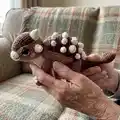
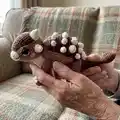
22sc up; 10sc straight; 22sc down; 4sc straight (58) (see photos 1-3)
Round 24 :
4sc, dec, 10sc, dec, 18sc, dec, 10sc, dec, 8sc (54)
Round 28 :
[7sc, dec]x6 (48)
Round 29 :
[6sc, dec]x6 (42)
Round 30 :
[5sc, dec]x6 (36)
Round 31 :
[sc, dec]x12 (24)
Round 1 :
5 loops, turning, 4sc (starting from the 2nd loop from the hook), 4sc (from the back of the chain) (8)
Round 2 :
[sc, inc]x4 (12)
Round 3 :
12sc, sl st in the 1st sc (12)
Info :
Cut and fix the thread, leaving a long end for sewing. Sew the muzzle to the head as shown on photo 5. Insert safety eyes between the rounds 26 and 27, the distance between them is approximately 12 stitches, don't fix yet (see photo 6).
Info :
Using the yarn needle to do from above of the eye "loose stitch" of black thread floss (see photos 7, 8). Separate one thread and fasten with a needle "loose stitch" in the middle of the eye (see photos 9, 10). In the same way, embroider one more "loose stitch" 1 mm higher than the previous one, in order to get an oval shape (see photos 11-14).
Info :
Using yarn needle to do from below the eye "loose stitch" of white thread floss (see photos 15, 16). Separate one thread and fasten with a needle "loose stitch" (see photo 17). Press the eye to the embroidered line and fasten it.
Info :
Divide the black threads floss in half, embroider the nostrils and mouth (see photos 18-24).
Info :
Completely fill the head. Insert cotter pin into shim (see photo 31). Place cotter pin between 31 and 32 round of the head as shown on photos 32, 33.
Info :
Trim the thread. Pass the thread through all the loops using a yarn needle. Tighten and secure.
— Spikes (Yarn C) :
Small 2 pcs - Round 1 :
2 loops, 4sc in 2nd loop from hook (amigurumi ring) (4)
Small - Round 3 :
[inc]x4 (8)
Small - Round 4 :
[3sc, inc]x2 (10)
Small - Round 5 :
10sc (10)
Small - Round 6 :
[4sc, inc]x2 (12)
Small - Round 7-8 :
12sc (12)
Info :
Cut and fix the thread, leaving a long end for sewing. Slightly stuff the spikes with synthepus and sew it to the head.
Big 2 pcs - Round 1 :
2 loops, 3sc in 2nd loop from hook (amigurumi ring) (3)
Big - Round 2 :
sc, inc, sc (4)
Big - Round 3 :
[sc, inc]x2 (6)
Big - Round 4 :
[inc]x6 (12)
Big - Round 5 :
[2sc, inc]x4 (16)
Big - Round 7 :
[7sc, inc]x2 (18)
Big - Round 8-9 :
18sc (18)
Info :
Cut and fix the thread, leaving a long end for sewing. Slightly stuff the spikes with synthepus and sew it to the head (see photos 34-36).
— Tail (Yarn A) :
Round 1 :
2 loops, 6sc in 2nd loop from hook (amigurumi ring) (6)
Info :
Cut and fix the thread. Crochet the second detail according to the same scheme, do not cut the thread. To connect the details insert the hook initially into the first detail (from the inside to the outside), and then into the second detail (from the outside to the inside) (see photos 37, 38).
Round 6 (incomplete) :
crochet 3sc of the first detail together with 3sc of the second detail, then crochet 6sc along the second detail
Round 7 :
crochet 6sc on the first part, crochet 6sc on the second part (12)
Round 6 :
[4sc, dec]x2 (10)
Round 7 :
[3sc, dec]x2 (8)
Round 8 :
[2sc, dec]x2 (6)
Round 11 :
sc, [inc]x2, 3sc (8)
Round 13 :
2sc, [inc]x2, 4sc (10)
Round 15 :
3sc, [inc]x2, 5sc (12)
Round 16 :
5sc, [inc]x2, 5sc (14)
Round 17 :
7sc, [inc]x2, 5sc (16)
Round 18 :
8sc, [inc]x2, 6sc (18)
Info :
Cut and fix the thread. Mark with a pin the place where the tail connect to the back - move the pin to the 12th loop right from the beginning of the round (see photo 51). If you decide not to use wire, then stuff the tail with synthepus.
— Body - Back (Yarn A) :
Round 1 :
14 loops, turning, 13sc (starting from the 2nd loop from the hook) (13)
Round 2 :
1 loop, turning, 13sc (13)
Round 3 :
1 loop, turning, inc, 11sc, inc (15)
Round 4 :
1 loop, turning, 15sc only through front loops (15)
Round 5 :
1 loop, turning, inc, 13sc, inc (17)
Round 6 :
1 loop, turning, 17sc (17)
Round 7 :
1 loop, turning, inc, 15sc, inc (19)
Round 8 :
1 loop, turning, 19sc only through front loops (19)
Round 9-11 :
1 loop, turning, 19sc (19)
Round 12 :
1 loop, turning, 19sc only through front loops (19)
Round 13 :
1 loop, turning, 19sc (19)
Round 14 :
1 loop, turning, dec, 15sc, dec (17)
Round 15 :
1 loop, turning, 17sc (17)
Round 16 :
1 loop, turning, 17sc only through front loops (17)
Round 17 :
1 loop, turning, dec, 13sc, dec (15)
Round 18 :
1 loop, turning, dec, 11sc, dec (13)
Round 19 :
1 loop, turning, dec, 9sc, dec (11)
Round 20 :
1 loop, turning, dec, 7sc, dec only through front loops (9)
Round 21 :
1 loop, turning, dec, 5sc, dec (7)
Round 22 :
1 loop, turning, dec, 3sc, dec (5)
Info :
Connect the back with the tail in the next round. To connect the details insert the hook initially into the tail (from the inside to the outside), and then into the back (from the outside to the inside) (see photos 52-55).
Round 23 :
1 loop, turning, crochet 5sc of the back together with 5sc of the tail (see photo 56)
Info :
Next change the color to yarn B. To get a beautiful line when changing color in the next row (the same way as for the head) crochet part of the sc in this way - half of the sc with dark-brown (yarn A), and the other half with light-brown (yarn B). Crochet the body around the perimeter in a counter-clockwise direction from the point "Start" (see photo 57).
Round 24 :
crochet 22sc, 13sc, 22sc on the back; crochet 13sc on the tail (70) (see photos 58, 59)
Info :
Sew the holes between the tail and the back using extra thread (see photo 60).
Round 28 :
[5sc, dec]x10 (60)
Round 29 :
[8sc, dec]x6 (54)
— Neck (Yarn C) :
Round 1 :
5 loops, turning, 4sc (starting from the 2nd loop from the hook) (4)
Round 2 :
1 loop, turning, inc, 2sc, inc (6)
Round 3 :
1 loop, turning, inc, 4sc, inc (8)
Round 4 :
1 loop, turning, inc, 6sc, inc (10)
Info :
Crochet the neck around the perimeter in a counter-clockwise direction from the point "Start" (see photo 61).
Round 10 :
8sc down; 4sc straight; 8sc up, 10sc straight (30)
Info :
Mark with a pin the place where the neck connect to the body - move the pin for 1 loop right from the beginning of the round (see photo 62). Cut and fix the thread.
Info :
Continue crochet the body, change the thread to yarn C. Connect the body with the neck in the next round. To connect the details insert the hook initially into the neck (from the inside to the outside), and then into the body (from the outside to the inside) (see photos 63-67).
Round 30 :
crochet 9sc, dec, 7sc along the body; crochet 10sc of the body together with 10sc of the neck; then crochet 2sc, dec, [9sc, dec]x2 along the body (see photo 68) (60)
Round 31-33 :
60sc (60) (see photo 69)
Info :
Insert cotter pin between 6 and 7 row of the neck (in the middle, see photos 70, 71). Put the disk on cotter pin and wrap the ends in the "rings" with the help of round-nosed pliers (see photos 72-75).
Round 34 :
[3sc, dec]x12 (48)
Round 35 :
[2sc, dec]x12 (36)
Round 36 :
[sc, dec]x12 (24)
Round 37 :
[2sc, dec]x6 (18)
Round 38 :
[sc, dec]x6 (12)
Info :
Completely fill the body.
— Plates (Yarn C) :
Small (8 pcs) Round 1 :
2 loops, 4sc in 2nd loop from hook (amigurumi ring) (4)
Small Round 2 :
[sc, inc]x2 (6)
Info :
Cut and fix the thread, leaving a long end for sewing.
Middle (10 pcs) Round 1 :
2 loops, 6sc in 2nd loop from hook (amigurumi ring) (6)
Middle Round 2 :
[2sc, inc]x2 (8)
Middle Round 4 :
[3sc, inc]x2 (10)
Info :
Cut and fix the thread, leaving a long end for sewing.
Big (4 pcs) Round 1 :
2 loops, 6sc in 2nd loop from hook (amigurumi ring) (6)
Big Round 2 :
[sc, inc]x3 (9)
Big Round 3 :
[2sc, inc]x3 (12)
Info :
Slightly stuff the plates with synthepus. Cut and fix the thread, leaving a long end for sewing (see photo 79). Sew the plates to the back, placing them on the lines of the remaining back loops in a checkerboard pattern as shown on photos 80, 81.
— Legs (Yarn B) :
Front, 2 pcs - Round 1 :
5 loops, turning, 4sc (starting from the 2nd loop from the hook), 4sc (from the back of the chain) (8)
Front Round 2 :
3sc in the next loop, 6sc, 3sc in the next loop (12)
Front Round 3 :
only through back loops 12sc (12)
Front Round 4-5 :
[inc]x2, 3sc, {sc3tog}*, 4sc (12)
Front Round 6 :
[dec]x2, 3sc, [inc]x2, 3sc (12)
Info :
Start stuffing the leg with synthepus.
Front Round 8 :
[dec]x2, 3sc, [inc]x2, 3sc (12)
Front Round 9-14 :
12sc (12)
Front Round 15 :
[sc, dec]x4 (8)
Front Round 16 :
[2sc, dec]x2 (6)
Info :
Trim the thread. Pass the thread through all the loops using a yarn needle. Tighten and secure.
Back, 2 pcs - Round 1 :
5 loops, turning, 4sc (starting from the 2nd loop from the hook), 4sc (from the back of the chain) (8)
Back Round 2 :
3sc in the next loop, 6sc, 3sc in the next loop (12)
Back Round 3 :
only through back loops 12sc (12)
Back Round 4-5 :
[inc]x2, 3sc, {sc3tog}*, 4sc (12)
Back Round 6 :
[dec]x2, 3sc, [inc]x2, 3sc (12)
Info :
Start stuffing the leg with synthepus.
Back Round 8 :
[dec]x2, 3sc, [inc]x2, 3sc (12)
Back Round 9-12 :
12sc (12)
Back Round 13 :
[sc, dec]x4 (8)
Back Round 14 :
[2sc, dec]x2 (6)
Info :
Trim the thread. Pass the thread through all the loops using a yarn needle. Tighten and secure.
Toes :
THOES, 3 pcs on each leg (Yarn C, in two folds). Embroider 3 toes on each leg with French knot (see photos 85-90).
— Assembly :
Info :
Sew your crocheted legs to the body with a threaded bracing (use round-nosed pliers to make it easier to pull the needle). For this, it is necessary:
Step 1 :
Attach the legs using needles for cutting (front legs between 29 and 30 rounds of body, distance between legs approx 24 stitches, back legs between 25 and 26 rounds of body, distance between legs approx 16 stitches - view from above, see photos 91-93). Check that the dinosaur stand steadily. Detach the arms and legs without removing the needles from them, and insert other needles for cutting in their place (see photo 94, 95).
Step 2 :
Insert the needle through the back into the front leg attachment point (leaving the loose end of the thread outside) (see photo 96, 97).
Step 3 :
Thread the needle through two loops on the inner surface of the leg (the needle for cutting must be in the middle) (see photo 98).
Step 4 :
Insert the needle into the body at the leg attachment point and pull out it at the point of attachment of the second leg (see photo 99). Continue sewing as described and secure all seams.
This little Ankylosaurus Bruno is perfect for handmade gifts and display — packed with personality in a pocket-sized form. The pattern includes complete rounds, plates, spikes and assembly tips to help you finish Bruno just like the photos. Whether you keep him on your shelf or make one for a friend, he will bring smiles and handmade charm. 🧶🧸