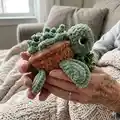
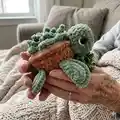
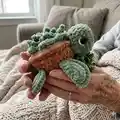
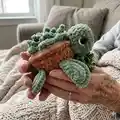
About This Succulent Turtle Amigurumi Pattern
This pattern creates a plush succulent-topped turtle using size 6 super-bulky chenille yarn for a squishy, soft finish. Youll crochet a rounded shell worked in back loops with a separate spiral succulent worked into the front loops for layered texture. The design includes instructions for head, legs, tail, and how to attach pieces into the body for a neat, stable finish.
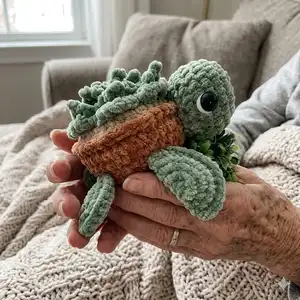
Clear round-by-round instructions guide you through shaping and assembly, with photos referenced for placement. The succulent top is made in a continuous spiral to create 16 leafy segments for a realistic look.
Why You'll Love This Succulent Turtle Amigurumi Pattern
I absolutely love this pattern because it combines classic amigurumi shaping with a playful succulent detail that makes the turtle unique. I enjoy how the chenille yarn creates a super-soft, huggable toy that still holds nice stitch definition for the succulent leaves. The construction is satisfying — you crochet the shell base in BLO and then build the succulent in the front loops for a layered effect I find very rewarding. And sewing the legs and tail into the body round gives the finished piece a very neat, polished look I always appreciate.
Switch Things Up
I love to change colors to create different moods for the turtle; try pastels for a soft nursery look or bold jewel tones for a statement piece.
I often swap the chenille yarn for a worsted weight yarn and a smaller hook to make a mini version suitable for keychains or tiny gifts.
I sometimes use a chunkier bulky yarn and a larger hook to make a super-cuddly oversized turtle that doubles as a pillow or nursery decor.
For the succulent, try alternating two close shades of green to create depth between inner and outer leaves, making the spiral more dimensional.
I add embroidered details like small freckles or a smile to change the turtles expression and give each one a unique personality.
Want poses? I sometimes add a short piece of floral wire inside the legs before stuffing to make them poseable and adjustable.
Swap safety eyes for embroidered eyes for a toddler-safe version, and use felt highlights glued on for an extra shiny eye detail.
Try making a family set by crocheting multiple turtles in coordinating colors and arranging them on a shelf or gifting them as a set.
I also like to add tiny felt or crocheted accessories like a flower on the shell or a miniature blanket for seasonal variations.
Finally, experiment with yarn textures such as boucle or faux fur for novelty versions, and always adjust stuffing and hook size to match the new yarn for best results.
Common Mistakes & How to Fix Them
✗ Skipping stitch markers when working front and back loops can cause lost loop alignment; place stitch markers to mark the first front loop of each round so you know where to start the succulent and subsequent rounds.
✗ Forgetting to fold and work through both sides when making leg half-circles will give the wrong shape; always fold the circle in half and SC through both layers around the curve until you reach the end to form a proper leg.
✗ Attaching legs and tail into the wrong body round will misplace limbs; attach your legs and tail into the specified round (round 11) by inserting your hook through the leg/tail first then the body stitch to ensure correct placement.
✗ Not stuffing as you go can make shaping difficult and lumpy; stuff gradually to your desired firmness before closing, especially the head and body, to achieve smooth shaping.
✗ Changing color or dropping yarn incorrectly can leave loose loops; when switching to Terracotta for the shell underside, secure your yarn tails and weave ends in as instructed to keep the shell neat.