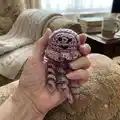
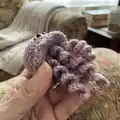
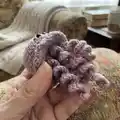
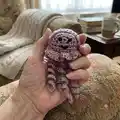
About This Ragdoll Pocket Jellyfish Amigurumi Pattern
This pattern creates a tiny pocket jellyfish amigurumi with a domed head and lots of curly tentacles. You will work two identical body halves, join them, add safety eyes and embroidered features, and make spiral tentacles for a playful finish. Techniques include working flat rows, joining edges with single crochet, and working in loops to create curled tentacles.
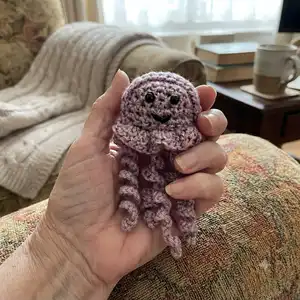
Perfect for using up DK scraps, it makes a lovely keyring or pocket buddy. Step-by-step photos are included to guide you through assembly and finishing.
Why You'll Love This Ragdoll Pocket Jellyfish Amigurumi Pattern
I absolutely love this pattern because it turns a few simple stitches into a joyful little companion. I enjoy how quickly the jellyfish comes together — it is satisfying to make and finishes in an afternoon. The curly tentacles are a playful detail that adds personality with very little extra time. I also love that it is a great scrap buster and can be customized with different yarns and eye sizes to create varied looks.
Switch Things Up
I love customizing this pocket jellyfish by changing yarn weight and hook size to make different scales of friends.
I often use pastel DK yarn for a soft baby-friendly look or a bright acrylic for a playful keyring version.
Try swapping the safety eyes for French knots or embroidered eyes if you prefer a fully soft toy without plastic components.
You can vary tentacle length and number: fewer longer spirals for a flowing look or many short spirals for a dense, playful skirt.
I sometimes add tiny beads to the ends of tentacles or stitch sequins into the ruffle for a sparkly effect.
If I want it extra sturdy as a keyring I use a metal keyring and reinforce the top with several stitches and a bit of glue on the knot.
To make a mini set, I use fingering weight yarn and a 2.5mm hook, which creates adorable tiny pocket pals perfect for gifts.
I also enjoy embroidering different mouth expressions to change the jellyfish personality — a straight smile, an open O, or a little tongue can all be fun.
For a beachy theme I crochet in variegated yarns or use a cotton blend that gives a crisp stitch definition to the ruffles.
Lastly, I recommend experimenting with stuffing levels: a softer stuffing makes a squishier jellyfish, while firmer stuffing gives more structure and a pronounced dome.
Common Mistakes & How to Fix Them
✗ Not placing safety eyes before joining can make placement difficult later; place and test eyes on the second body piece before joining and stuffing.
✗ Overstuffing the body makes the finished shape stiff and bulky; stuff gradually and evenly until you reach a soft, firm shape.
✗ Skipping counting stitches during row increases leads to uneven edges; count your stitches after each increase row to maintain correct totals.
✗ Working into both loops instead of the specified inside or outside loops can change how the tentacle row behaves; follow the instruction to work in inside loops only for the straight part and exterior loops for the DC round.