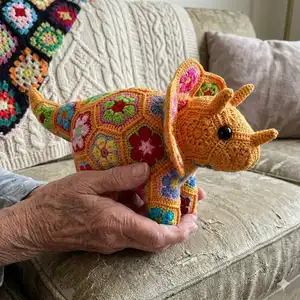
Make a colorful African Flower Triceratops named Plod using small motifs joined together. This pattern guides you through hexagons, pentagons, heptagons, octagons and squares, plus step-by-step joining to build the toy. You will learn join-as-you-go techniques and motif construction to create a sturdy, stuffed dino full of personality. Perfect for stash-busting and those who love bright, hand-crafted toys.
Progress Tracker
0% Complete
— African Flower Hexagon Crochet Motif Instructions :
Round 1 :
Ch5 and join with slip stitch to form a ring. Ch3 (counts as first dc), 1 dc in ring, ch1. Then, make * 2 dc in ring, ch1 *. Repeat from * to * 4 times more, slip stitch join to third chain of beginning ch3 of the round. Cut yarn and pull through. (6 sets of 2dc's separated by chain stitches).
Round 2 :
Join next color in the ch1 space (just to the right of the previous round's ch3 beginning) and ch3 (counts as first dc). Make a dc in that same chain space then ch1. Make 2 dc (still in the same chain space). Move on to the next chain space of the previous round, and make the following: 2 dc, ch1, 2dc in that chain space. Repeat this in each of the next 4 chain spaces. Join with slip stitch to third chain of beginning ch3 of the round. (6 clusters of [2dc,ch,2dc])
Round 3 :
Continue with the same colour. Slip stitch into the chain space in the middle of the first cluster of the previous round. Ch3 (counts as first dc). Make 6 dc in same chain space (total of 7 dc's). Make 7 dc into the chain space of the next cluster. Repeat 4 more times, so that each cluster has 7 dc's in its chain space. Join with slip stitch to the third chain of the beginning ch3 of the round. Cut yarn and pull through. (6 sets of 7 dc's).
Round 4 :
Join new colour in the slip stitch of previous round's end, and ch1 (counts as a sc). Make one sc into each of the dc's of the cluster (this makes 7 sc including the ch1). Make one long dc (between clusters) that extends down into round 2 of the flower, so that it separates the round 2 clusters. Sc into each of the 7 dc stitches of the next cluster. Make one long dc (between clusters) that extends down into round 2 of the flower, so that it separates the round 2 clusters. Repeat from * to * four more times. Slip stitch to the beginning of the round ch1 stitch. Cut yarn and pull through. (42 sc and 6 long dc)
Round 5 :
Join next colour to the slip stitch at the end of the previous round. Ch3 (counts as first dc). Make one dc into each of the next 2 sc's, then (dc, ch1, dc) into the next sc (this forms the apex of the flower petal). Then make one dc into each of the next three sc. Make one dc into the previous round's long dc stitch. Make one dc into each of the next petal's first three sc stitches, then (dc, ch1, dc) into the next sc (this forms the apex of the petal), then make one dc into each of the next three sc. Make one dc into the previous round's long dc stitch. Repeat from * to * four more times. Slip stitch to the third chain of the ch3 of the beginning of the round. Cut yarn and pull through. You should have nine dc stitches between each petal apex, separated by a chain stitch, so 54 dc in all.
— African Flower Pentagon Crochet Motif Instructions :
Round 1 :
Ch5 and join with slip stitch to form a ring. Ch3 (counts as first dc), 1 dc in ring, ch1. Then, make * 2 dc in ring, ch1 *. Repeat from * to * 3 times more, slip stitch join to third chain of beginning ch3 of the round. Cut yarn and pull through, leaving a tail. (5 sets of 2dc's separated by chain stitches).
Round 2 :
Join next color in the ch1 space (just to the right of the previous round's ch3 beginning) and ch3 (counts as first dc). Make a dc in that same chain space then ch1. Make 2 dc (still in the same chain space). Move on to the next chain space of the previous round, and make the following: 2 dc, ch1, 2dc in that chain space. Repeat this in each of the next 3 chain spaces. Join with slip stitch to third chain of beginning ch3 of the round. (5 clusters of [2dc,ch,2dc])
Round 3 :
Continue with the same colour. Slip stitch into the chain space in the middle of the first cluster of the previous round. Ch3 (counts as first dc). Make 6 dc in same chain space (total of 7 dc's). Make 7 dc into the chain space of the next cluster. Repeat 3 more times, so that each cluster has 7 dc's in its chain space. Join with slip stitch to the third chain of the beginning ch3 of the round. Cut yarn and pull through, leaving a tail. (5 sets of 7 dc's).
Round 4 :
Join new colour in the slip stitch of previous round's end, and ch1 (counts as a sc). Make one sc into each of the dc's of the cluster (this makes 7 sc including the ch1). Make one long dc (between clusters) that extends down into round 2 of the flower, so that it separates the round 2 clusters. Sc into each of the 7 dc stitches of the next cluster. Make one long dc (between clusters) that extends down into round 2 of the flower, so that it separates the round 2 clusters. Repeat from * to * three more times. Slip stitch to the beginning of the round ch1 stitch. Cut yarn and pull through, leaving a tail. (35 sc and 5 long dc)
Round 5 :
Join next colour to the slip stitch at the end of the previous round. Ch3 (counts as first dc). Make one dc into each of the next 2 sc's, then (dc, ch1, dc) into the next sc (this forms the apex of the flower petal). Then make one dc into each of the next three sc. Make one dc into the previous round's long dc stitch. Make one dc into each of the next petal's first three sc stitches, then (dc, ch1, dc) into the next sc (this forms the apex of the petal), then make one dc into each of the next three sc. Make one dc into the previous round's long dc stitch. Repeat from * to * three more times. Slip stitch to the third chain of the ch3 of the beginning of the round. Cut yarn and pull through. You should have nine dc stitches between each petal apex, separated by a chain stitch, so 45 dc in all.
— African Flower Heptagon Crochet Motif Instructions :
Round 1 :
Ch5 and join with slip stitch to form a ring. Ch3 (counts as first dc), 1 dc in ring, ch1. Then, make * 2 dc in ring, ch1 *. Repeat from * to * 5 times more, slip stitch join to third chain of beginning ch3 of the round. Cut yarn and pull through, leaving a tail. (7 sets of 2dc's separated by chain stitches).
Round 2 :
Join next color in the ch1 space (just to the right of the previous round's ch3 beginning) and ch3 (counts as first dc). Make a dc in that same chain space then ch1. Make 2 dc (still in the same chain space). Move on to the next chain space of the previous round, and make the following: 2 dc, ch1, 2dc in that chain space. Repeat this in each of the next 5 chain spaces. Join with slip stitch to third chain of beginning ch3 of the round. (7 clusters of [2dc,ch,2dc])
Round 3 :
Continue with the same colour. Slip stitch into the chain space in the middle of the first cluster of the previous round. Ch3 (counts as first dc). Make 6 dc in same chain space (total of 7 dc's). Make 7 dc into the chain space of the next cluster. Repeat 5 more times, so that each cluster has 7 dc's in its chain space. Join with slip stitch to the third chain of the beginning ch3 of the round. Cut yarn and pull through, leaving a tail. (7 sets of 7 dc's).
Round 4 :
Join new colour in the slip stitch of previous round's end, and ch1 (counts as a sc). Make one sc into each of the dc's of the cluster (this makes 7 sc including the ch1). Make one long dc (between clusters) that extends down into round 2 of the flower, so that it separates the round 2 clusters. Sc into each of the 7 dc stitches of the next cluster. Make one long dc (between clusters) that extends down into round 2 of the flower, so that it separates the round 2 clusters. Repeat from * to * five more times. Slip stitch to the beginning of the round ch1 stitch. Cut yarn and pull through, leaving a tail. (49 sc and 7 long dc)
Round 5 :
Join next colour to the slip stitch at the end of the previous round. Ch3 (counts as first dc). Make one dc into each of the next 2 sc's, then (dc, ch1, dc) into the next sc (this forms the apex of the flower petal). Then make one dc into each of the next three sc. Make one dc into the previous round's long dc stitch. Make one dc into each of the next petal's first three sc stitches, then (dc, ch1, dc) into the next sc (this forms the apex of the petal), then make one dc into each of the next three sc. Make one dc into the previous round's long dc stitch. Repeat from * to * five more times. Slip stitch to the third chain of the ch3 of the beginning of the round. Cut yarn and pull through. You should have nine dc stitches between each petal apex, separated by a chain stitch, so 63 dc in all.
— African Flower Octagon Crochet Motif Instructions :
Round 1 :
Ch5 and join with slip stitch to form a ring. Ch3 (counts as first dc), 1 dc in ring, ch1. Then, make * 2 dc in ring, ch1 *. Repeat from * to * 6 times more, slip stitch join to third chain of beginning ch3 of the round. Cut yarn and pull through, leaving a tail. (8 sets of 2dc's separated by chain stitches).
Round 2 :
Join next color in the ch1 space (just to the right of the previous round's ch3 beginning) and ch3 (counts as first dc). Make a dc in that same chain space then ch1. Make 2 dc (still in the same chain space). Move on to the next chain space of the previous round, and make the following: 2 dc, ch1, 2dc in that chain space. Repeat this in each of the next 6 chain spaces. Join with slip stitch to third chain of beginning ch3 of the round. (8 clusters of [2dc,ch,2dc])
Round 3 :
Continue with the same colour. Slip stitch into the chain space in the middle of the first cluster of the previous round. Ch3 (counts as first dc). Make 6 dc in same chain space (total of 7 dc's). Make 7 dc into the chain space of the next cluster. Repeat 6 more times, so that each cluster has 7 dc's in its chain space. Join with slip stitch to the third chain of the beginning ch3 of the round. Cut yarn and pull through, leaving a tail. (8 sets of 7 dc's).
Round 4 :
Join new colour in the slip stitch of previous round's end, and ch1 (counts as a sc). Make one sc into each of the dc's of the cluster (this makes 7 sc including the ch1). Make one long dc (between clusters) that extends down into round 2 of the flower, so that it separates the round 2 clusters. Sc into each of the 7 dc stitches of the next cluster. Make one long dc (between clusters) that extends down into round 2 of the flower, so that it separates the round 2 clusters. Repeat from * to * six more times. Slip stitch to the beginning of the round ch1 stitch. Cut yarn and pull through, leaving a tail. (56 sc and 8 long dc)
Round 5 :
Join next colour to the slip stitch at the end of the previous round. Ch3 (counts as first dc). Make one dc into each of the next 2 sc's, then (dc, ch1, dc) into the next sc (this forms the apex of the flower petal). Then make one dc into each of the next three sc. Make one dc into the previous round's long dc stitch. Make one dc into each of the next petal's first three sc stitches, then (dc, ch1, dc) into the next sc (this forms the apex of the petal), then make one dc into each of the next three sc. Make one dc into the previous round's long dc stitch. Repeat from * to * six more times. Slip stitch to the third chain of the ch3 of the beginning of the round. Cut yarn and pull through. You should have nine dc stitches between each petal apex, separated by a chain stitch, so 72 dc in all.
— African Flower Square Crochet Motif Instructions :
Info :
There are two square motifs used in the making of Plod. The square has only 4 rounds instead of 5. If you are using the JAYG method, make the square only up to round 3 before starting the JAYG, which creates Round 4 (the final round).
Round 1 :
Ch5 and join with a slip stitch to make a ring. Ch3 (counts as first dc), then make 1 dc into the ring, ch1. Make * 4 dc into ring, ch1. * Repeat from * to * twice more. Make 2 dc into ring and join with a slip stitch to the third chain of the ch3 of the beginning of the round. (4 sets of 4dc's separated by chain stitches)
Round 2 :
If you choose, you can join a new color yarn. Ch3 into a chain space of Round 1. If you choose not to change colors, first slip stitch into the next along chain space, then Ch3 (counts as first dc). Make 7 dc into this same chain space. Make 8 dc's into each of the three remaining chain spaces of Round 1. Join with a slip stitch to the third chain of the Ch3 beginning of Round 1. (4 clusters of 8 dc's)
Round 3 :
Join a new color if you wish. Ch1 into the slip stitch of the previous round. Sc into each of the seven dc's of this cluster. Sc into each of the 8 dc's of the next cluster. Repeat for the remaining two clusters. Join with a slip stitch to the ch1 at the beginning of the round. (4 sets of 8 sc's)
Round 4 :
Join a new color yarn to the slip stitch of round 3. Ch3 (counts as first dc). Make a dc into each of the next four sc stitches. Ch1, then make a dc into the same sc space as the previous dc. Make a dc into each of the next eight sc's from Round 3. Ch1. Repeat from * to * two times more. Make a dc into the same sc space as the previous dc. Make a dc into each of the next three sc stitches of Round 3. Join with a slip stitch to the third chain of the ch3 at the beginning of the round. (4 sets of 9 dc's separated by 4 chain stitches, i.e. four gdc repeats)
— Making the Feet and Belly :
Info :
You will start by making all four of Plod's feet. Each foot is made up of two pentagons which are joined along THREE SIDES to each other. Complete a pentagon up to round 5. Take a second pentagon made up to Round 4 and join it to the completed pentagon along THREE SIDES to create a pocket shape for the foot.
Step :
Make three more feet in the same way, pop open each foot so you see half of each pentagon, and place the four opened-up feet as shown in the photos. The feet will be arranged to attach to the belly octagon.
Step :
Next, you will join the belly octagon. Join one side at a time so you do not get confused. The first TWO SIDES of the belly octagon are joined to the top INNER pentagons. After each join check orientation and ensure the correct sides are matched to create the tummy pocket.
— Joining a full row of Hexagons to the Body Base :
Info :
The next steps involve joining a full row of hexagons around the body base you have just made. You will need 8 hexagons for this part. Open up each foot and place on your work table as shown. You will be facing the wrong side of the belly octagon when joining.
Step 1 :
The first hexagon will be joined along TWO SIDES to the body. The first side joins to the left-hand front leg pentagon and the second side to one free side of the belly octagon. When joined the body begins to take shape.
Step 2 :
Turn the work so you are facing the bum end. Join a hexagon on three sides to the body: the first side is joined to the hexagon added previously, the second and third sides join to the left hind leg. Continue adding hexagons, joining along three sides where indicated in the photo sequence, and along two sides on edge positions.
Step 3 :
Work around the body adding hexagons in sequence. When joining on three sides be careful to match petal apex to petal apex and align the chain-space joins according to the colored guide lines. Your body will gradually become a continuous ring of motifs.
— Making Plod\'s tail :
Step :
Turn the work so you are facing the bum end of the body. Join a hexagon to the V-shaped area between two bum hexagons as shown, along two sides. The next motif to join is a pentagon joined only along one side as shown in the photos. Continue adding motifs for part of the tail, leaving a small hole to allow stuffing the tail more easily before finishing.
Info :
Finish the tail assembly by completing the remaining joins shown in the photo tutorials. The sequence of joins will create the tapered tail shape. Stuff the tail lightly before closing the final seams.
This playful African Flower Triceratops is a bright, colorful project that turns small motifs into a lovable stuffed companion. The pattern mixes crochet technique with a delightful puzzle-like assembly that is rewarding to complete. Make one for yourself or as a cheerful handcrafted gift full of personality and charm. 🧶🧵