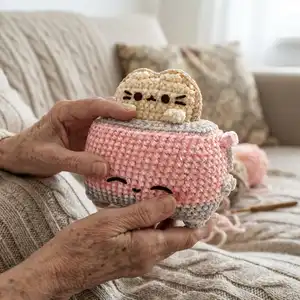
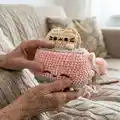
Bring a tiny, squishy Kitty Toaster to life with this charming crochet pattern. Youll make two kitty bread slices and a cute toaster with removable inner parts — perfect for gifting or desk decor. Clear step-by-step rounds, assembly tips, and facial templates make finishing a joy. Suitable for crocheters who know basic stitches and enjoy a sweet, small project.
Progress Tracker
0% Complete
— Kitty Bread (Make 2) :
Info :
We will work in ROWS here. Start with Beige.
Info :
TIPS: At the end of each row, turn your work, pull your hook slightly, and continue to the next row. DO NOT ch 1 at the end, as this makes the edges appear neater. I recommend inserting stitch markers on both sides of the row if you find it difficult to see where to insert your hook.
Round 1 :
Ch16, starting from the 2nd ch from the hook, 15sc (15)
Round 2-12 :
15sc, turn (15) 11rows
Round 13 :
sc2tog, 11sc, sc2tog, turn (13)
Info :
We are going to make the ears now, DO NOT ch 1 before turning. Please read through R14 before making it.
Round 14 :
sc2tog, 4sc, turn, sk 1, 3sc, turn, sk 1, 2sc (we will sc the sides too, see pic for reference), 2sc (the sides), 5sc, turn, sk 1, 3sc, turn, sk 1, 2sc, 2sc (the sides), sc2tog (12)
Info :
Picture f is a picture of the first ear (before making 5sc) for reference.
— Bread Sides :
Info :
Change to Brown and continue working around the sides of the bread. We will inc on the 2 edges of the bread. I recommend adding a stitch marker for the increases so itll be easier to sew later.
Round 15 :
12sc, inc, 13sc, inc, 13sc, 2sc, 2sc(the sides), 5sc, 2sc(the sides), 5sc (58)
Info :
SL ST in the 1st st. Leave a short yarn, and fasten off for the first piece. Make the second bread and leave a long yarn to sew. Fasten Off.
Info :
Adjust the bread pieces and sew the sides BLO. Use the stitch markers to indicate where to sew. Lightly stuff while sewing, DO NOT overstuff so the bread is still flat.
— Paws (make 2) :
Info :
In Beige. DO NOT stuff. Leave a long tail to sew and fasten off. Fold the paw in half and sew it close. You can sew it after you finish your toaster or sew it now. Sew it between R8 & R9 of the bread, 2 sts away from the sides and 5 sts apart between the hands.
— Toaster - Inner Part :
Info :
We will divide the toaster into 2 parts, inner and outer parts. First, we will work on the inner part of the toaster. In Grey. Well make a foundation chain and work around the chain.
Round 1 :
Ch 12, starting from the 2nd ch from the hook. 10sc, 3inc, on the other side of the chain, 10sc, 3inc (26)
Round 2 :
10sc, 3inc, sc, 3inc, 10sc, 3inc, sc, 3inc (34)
Round 3 :
11sc, 3inc, 3sc, 3inc, 12sc, 3inc, 3sc, 3inc, sc (42)
Round 4 :
12sc, 3inc, 5sc, 3inc, 14sc, 3inc, 5sc, 3inc, 2sc (50)
Info :
Note: 3inc = 3sc in the same st. We will FLO in the next round. We are crocheting from the inside out so you can flip it outwards if youre uncomfortable.
Round 5 :
FLO: 12sc, 3dec, 5sc, 3dec, 14sc, 3dec, 5sc, 3dec, 2sc (42)
Round 6 :
both loops: 42sc (42)
Round 7-12 :
42sc (42) 6rounds
Round 13 :
BLO: 13sc, 3inc, 5sc, 3inc, 14sc, 3inc, 5sc, 3inc, sc (50)
Info :
Flip back your inner toaster (if needed), the right side should be on the inside.
Round 14 :
both loops: 50 sc (50)
Round 15 :
14sc, 3inc, 7sc, 3inc, 16sc, 3inc, 7sc, 3inc, 2sc (58)
Info :
SL ST, Leave a short tail and fasten off. Weave in the tail.
— Legs (Make 4) :
Info :
Before working on the outer part we will make the 4 legs first so it is easier to sew before adding the cardboard. In Grey. Leave a long tail for sewing and fasten off. Lightly stuff if needed.
— Toaster - Outer Part :
Info :
We will make a foundation chain and work around the chain. Starting with Grey.
Round 1 :
Ch 12, starting from the 2nd ch from the hook. 10sc, 3inc, on the other side of the chain, 10sc, 3inc (26)
Round 2 :
10sc, 3inc, sc, 3inc, 10sc, 3inc, sc, 3inc (34)
Round 3 :
11sc, 3inc, 3sc, 3inc, 12sc, 3inc, 3sc, 3inc, sc (42)
Round 4 :
12sc, 3inc, 5sc, 3inc, 14sc, 3inc, 5sc, 3inc, 2sc (50)
Round 5 :
13sc, 3inc, 7sc, 3inc, 16sc, 3inc, 7sc, 3inc, 3sc (58)
Round 6 :
14sc, 3inc, 9sc, 3inc, 18sc, 3inc, 9sc, 3inc, 4sc (66)
Round 7 :
15sc, 3inc, 11sc, 3inc, 20sc, 3inc, 11sc, 3inc, 5sc (74)
Round 8 :
BLO: 15sc, 3dec, 11sc, 3dec, 20sc, 3dec, 11sc, 3dec, 5sc (66)
Round 9-10 :
66sc (66) 2rounds
Info :
Change color to Pink. Cut off the Grey yarn and hide the tail.
Round 11-12 :
66sc (66) 2rounds
Info :
After R12 we will sew the 4 legs to the bottom of the outer part. Sew it on each corner 1 st away from the edge (FLO line of R7). Then cut a cardboard slightly smaller than the bottom of the toaster so it fits in, make sure the FLO of R7 is visible on the side when you put in the cardboard. Glue the cardboard to secure it. Cut another one for the inner part of the toaster. Glue it on the wrong side bottom of the inner toaster.
Round 13-15 :
66sc (66) 3rounds
Round 16 :
sc, (14sc, dec)x2, sc, (14sc, dec)x2 (62)
Round 17-20 :
62sc (62) 4rounds
Round 21 :
sc, (13sc, dec)x2, sc, (13sc, dec)x2 (58)
Round 22 :
58sc (58) Leave a long tail to sew and fasten off.
Info :
We will now sew the toaster together. To make it easier to read Ill write it in points form: 1. Stuff 1/3 of the outer toaster. 2. Insert your Kitty Bread into the inner part of the toaster. 3. Place the inner part into the outer part of the toaster. 4. The last rounds of both parts should touch, if the inner part falls in you can add more stuffing, and vice versa. 5. Secure the corners with stitch markers, scrap yarn, or anything you have in your possession. 6. Lightly stuff the sides of the toaster (Do not overstuff, you can add more as you sew).
— Toaster Control :
Info :
Starting with Grey. Leave a long tail for sewing and fasten off.
Round 2 :
Change to Pink. BLO: 8sc (8)
Info :
SL ST, stuff if needed, Leave a long tail for sewing and fasten off.
— Carriage Lever :
Info :
In Pink. DO NOT stuff. Leave a long tail to sew and fasten off. Fold it in half and sew it close.
Round 1 :
Ch4, starting from the 2nd ch from the hook. 2sc, inc, on the other side of the chain 2sc, inc (8)
— Lever Base :
Round 1 :
In Grey: Ch6, starting from the 2nd ch from the hook, 5sc. Leave a long tail to sew and fasten off.
— Button :
Round 1 :
In Grey: 5sc in MR (5)
Info :
SL ST, DO NOT stuff. Leave a long tail to sew and fasten off.
— ASSEMBLY :
Info :
This is where I sewed my pieces. However, I encourage you to use sewing pins and attach the pieces before sewing to see if its up to your liking! Sew the Toaster Control BLO on R10-14. Sew the Button BLO on R11-14. Sew the Lever Base on R15-21. Sew the Carriage Lever on R21.
— FACIAL ASSEMBLY (1) :
Info :
There are 2 face versions (normal & burnt) and you can choose which one youd like to make. I used brown felt for the facial expressions and pink eyeshadow for the blushes.
Item Name (Kitty Bread) :
Cut 2 eyes around 1-1.5 sts wide and place them on R10-R11, 4 sts apart. Cut the mouth around 2 sts wide and glue it on R11. Cut the Whiskers around 1.5-2 sts wide and glue them on R11 & R12 on both sides, 1 st away from the eyes.
Item Name (Toaster) :
Cut 2 eyes around 3-3.5 sts wide and place them on R13-R14, 4 sts apart. Cut the mouth around 1 st wide and glue it on R13. Use pink eyeshadow as the blush on the side of the eyes.
— FACIAL ASSEMBLY (2) :
Info :
For burnt kitty bread: Cut 2 eyes around 2-2.5 sts wide and place them on R11-R12, 3 sts apart. Cut the mouth around 1 st wide and glue it on R11. Cut the Whiskers around 1.5-2 sts wide and glue them on R11 & R12 on both sides, 1 st away from the eyes. Cut 3 curves for the cross-popping veins and glue them on R13-R14 using red felt. Use Dark Brown eyeshadow to make the burnt patches. For toaster burnt/sweat version: Cut 2 eyes around 2 sts wide and place them on R14-R15, 5 sts apart. Cut the mouth around 1-1.5 sts wide and glue it on R13. Cut a water drop for the sweat and glue it on R15-R17 using white felt. Use pink eyeshadow as the blush on the side of the eyes.
Info :
You can resize the facial expressions and print them out for guide. Congratulations and enjoy your purrfect toast!
This adorable Kitty Toaster pattern is a delightful mix of kawaii charm and clever construction, perfect for gifting or decorating your crafting nook. Make two kitty breads, add a sweet face with felt details, and assemble a sturdy two-part toaster with a cardboard base. Happy crocheting and enjoy every cozy stitch! 🧶 🧵