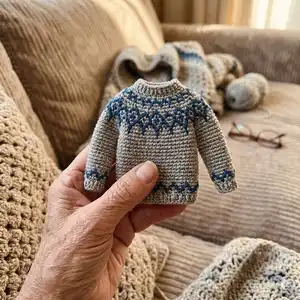
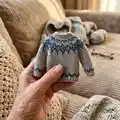
This top-down seamless ladies' sweater features a stunning circular yoke colorwork motif and comfortable raglan-style shaping. You will work the sweater from the neckline down, following clear charts and size-specific instructions for a perfect fit. The pattern includes multiple charts, short-row shaping for the yoke, sleeve divisions, and finishing details so you can create a professional-looking garment.
Progress Tracker
0% Complete
— Begin of work :
Info :
Using 1.5 mm [US000] needles and preferred cast-on method, cast on 152 (152; 152; 152) (152; 152; 168) (168; 168; 168) (180; 180; 180) (196; 196; 196) sts, place BoR marker, and join into the round without twisting.
Info :
Work in Ribbing pattern to a height of 3 cm [1.2 in] from cast-on edge, then change to 2.75 mm [US2] needles, and continue.
Info :
In the next round, increases a total of 2 (2; 2; 2) (2; 2; 0) (0; 0; 0) (2; 2; 2) (0; 0; 0) sts the following way:
Info :
Sizes 32, 34, 36, 38, 40, 42: slip BoR marker to right needle, RLI, k76, LLI, work in st st to end of round.
Info :
Sizes 52, 54, 56: slip BoR marker to right needle, RLI, k90, LLI, work in st st to end of round.
Info :
After having worked 7 rounds in st st, change to 3 mm [US2.5] needles, and continue from Circular Yoke Chart #1.
Info :
You now have a total of 154 (154; 154; 154) (154; 154; 168) (168; 168; 168) (182; 182; 182) (196; 196; 196) sts.
Info :
Work all rows of Chart #1, then continue from Chart #2 2 (2; 3; 4) (6; 7; 5) (6; 8; 10) (11; 9; 11) (12; 13; 14).
Info :
Complete all rows of the chart, then change to 2.75 mm [US2] needles, and continue by working 2 rounds of st st even.
Info :
You now have a total of 396 (396; 429; 440) (484; 506; 516) (528; 576; 600) (612; 637; 663) (676; 702; 728) sts.
Info :
To center the colorwork motif on the circular yoke, move the BoR marker by the number of sts listed for your size in the indicated direction:
Infos :
Size 32: 13 sts to the right. Size 34: 13 sts to the right. Size 36: 13 sts to the right. Size 38: 14 sts to the right. Size 40: 17 sts to the right. Size 42: 14 sts to the right. Size 44: 12 sts to the left. Size 46: 12 sts to the left. Size 48: 13 sts to the left. Size 50: 14 sts to the left. Size 52: 14 sts to the left. Size 54: 3 sts to the right. Size 56: 6 sts to the left. Size 58: 1 st to the right. Size 60: 1 st to the right. Size 62: don't move the marker.
— Short-row shaping of the yoke :
Next Round :
slip BoR marker, k37 (37; 39; 40) (45; 46; 48) (50; 56; 58) (61; 62; 63) (66; 67; 68), turn work to wrong side, slip 1 stitch purl-wise to the right needle, lead the working yarn behind the stitch, over the right needle. Pull the working yarn taut so both legs of the stitch sit on the right needle. Continue on the WS in purl.
Row 1 (RS) :
Work to marker M3, slip marker M3, knit to BoR marker, slip BoR marker, work to 5 sts before the Double Stitch, turn work to wrong side. Slip 1 stitch purl-wise to the right needle, lead the working yarn behind the stitch, over the right needle. Pull the working yarn taut so both legs of the stitch sit on the right needle. Continue on the WS in purl.
Row 2 (WS) :
Work to BoR marker, slip BoR marker, purl to marker M3, slip marker M3, work to 5 sts before the Double Stitch, turn work to right side, slip 1 stitch knit-wise, lead the working yarn behind the stitch, over the right needle. Pull the working yarn taut so both legs of the stitch sit on the right needle. Continue on the RS.
Info :
Repeat Rows 1 and 2 another 2 (2; 2; 2) (2; 2; 3) (3; 3; 3) (3; 3; 3) (3; 3; 3) times as indicated.
Next Row 3 (RS) :
knit to 3 sts before the Double Stitch, turn work to wrong side. Slip 1 stitch purl-wise to the right needle, lead the working yarn behind the stitch, over the right needle. Pull the working yarn taut so both legs of the stitch sit on the right needle. Continue on the WS in purl.
Row 4 (WS) :
purl to 3 sts before the Double Stitch, turn work to right side, slip 1 stitch knit-wise, lead the working yarn behind the stitch, over the right needle. Pull the working yarn taut so both legs of the stitch sit on the right needle. Continue on the RS.
Info :
Repeat Rows 3 and 4 another 2 (2; 2; 2) (2; 2; 3) (3; 3; 3) (3; 3; 3) (3; 3; 3) times as indicated.
Next Row 5 (RS) :
knit to 1 st before the Double Stitch, slip 1 stitch purl-wise to the right needle, lead the working yarn behind the stitch, over the right needle. Pull the working yarn taut so both legs of the stitch sit on the right needle. Continue on the WS in purl.
Row 6 (WS) :
purl to 1 st before the Double Stitch, turn work to right side, slip 1 stitch knit-wise, lead the working yarn behind the stitch, over the right needle. Pull the working yarn taut so both legs of the stitch sit on the right needle. Continue on the RS.
Info :
Repeat Rows 5 and 6 another 1 (1; 1; 1) (1; 1; 1) (2; 2; 2) (2; 2; 2) (2; 2; 2) times as indicated.
Info :
Continue, working st st in the round to BoR marker, knitting both legs of the Double Stitch together as one.
Info :
Work 0 (0; 0; 2) (2; 2; 4) (4; 4; 6) (6; 6; 6) (8; 8; 8) more rounds in st st.
— Dividing for the sleeves :
Next Round – dividing for the sleeves :
slip BoR marker to right needle, transfer 75 (75; 79; 81) (91; 93; 97) (101; 113; 116) (122; 124; 126) (132; 134; 137) right sleeve sts to a spare needle or stitch holder for holding, cast on 9 (13; 13; 13) (13; 13; 15) (17; 17; 17) (17; 19; 21) (21; 21; 21) new underarm sts, slip marker M1 to right needle, work over the sts of the Front in st st to marker M2, slip marker M2 to right needle, transfer 75 (75; 79; 81) (91; 93; 97) (101; 113; 116) (122; 124; 126) (132; 134; 137) left sleeve sts to a spare needle or stitch holder for holding, cast on 9 (13; 13; 13) (13; 13; 15) (17; 17; 17) (17; 19; 21) (21; 21; 21) new underarm sts, slip marker M3 to right needle, work over the sts of the Back in st st to BoR marker.
Info :
After having divided for the sleeves, you should have a total of 264 (272; 297; 304) (328; 346; 352) (360; 384; 402) (414; 427; 440) (467; 476; 496) sts.
Info :
Continue, working in st st in the round, slipping markers M1, M2, M3 and the BoR marker as you encounter them.
Info :
After having worked this way for 2 cm [0.8 in], begin working the vertical bust dart as follows:
Next Round 1 – decrease round :
slip BoR marker to right needle, work the 9 (13; 13; 13) (13; 13; 15) (17; 17; 17) (17; 19; 21) (21; 21; 21) sts of the side panel in st st, slip marker M1 to right needle, k2, k2tog, work in st st to 4 sts before marker M2, ssk, k2, slip marker M2 to right needle, work the 9 (13; 13; 13) (13; 13; 15) (17; 17; 17) (17; 19; 21) (21; 21; 21) sts of the side panel in st st, slip marker M3 to right needle, k2, k2tog, work in st st to 4 sts before the BoR marker, ssk, k2 = 4 sts decreased in this round.
Rounds 2–6 :
slip BoR marker to right needle, work 9 (13; 13; 13) (13; 13; 15) (17; 17; 17) (17; 19; 21) (21; 21; 21) sts of side panel in st st, slip marker M1 to right needle, work in st st to marker M2, slip marker M2 to right needle, work 9 (13; 13; 13) (13; 13; 15) (17; 17; 17) (17; 19; 21) (21; 21; 21) sts of side panel in st st, slip marker M3 to right needle, work in st st to BoR marker.
Info :
Repeat Rounds 1–6 another 3 (3; 3; 3) (2; 2; 2) (1; 1; 1) (1; 1; 1) (1; 1; 1) times. You now have a total of 248 (256; 281; 288) (316; 334; 340) (352; 376; 394) (406; 419; 432) (459; 468; 488) sts.
Info :
Now, work decreases as follows:
Next Round 1 :
slip BoR marker to right needle, work 9 (13; 13; 13) (13; 13; 15) (17; 17; 17) (17; 19; 21) (21; 21; 21) sts of side panel in st st, slip marker M1 to right needle, k2, k2tog, work in st st to 4 sts before marker M2, ssk, k2, slip marker M2 to right needle, work 9 (13; 13; 13) (13; 13; 15) (17; 17; 17) (17; 19; 21) (21; 21; 21) sts of the side panel in st st, slip marker M3 to right needle, work in st st to BoR marker = 2 sts decreased in this round.
Rounds 2–4 :
slip BoR marker to right needle, work 9 (13; 13; 13) (13; 13; 15) (17; 17; 17) (17; 19; 21) (21; 21; 21) sts of side panel in st st, slip marker M1 to right needle, work in st st to marker M2, slip marker M2 to right needle, work 9 (13; 13; 13) (13; 13; 15) (17; 17; 17) (17; 19; 21) (21; 21; 21) sts of side panel in st st, slip marker M3 to right needle, work in st st to BoR marker.
Info :
Repeat Rounds 1–4 another 3 times. You should now have a total of 240 (248; 273; 280) (308; 326; 332) (344; 368; 386) (398; 411; 424) (451; 460; 480) sts.
Info :
Work even for 5 cm [2 in] (the waist level should fall on the middle of this section).
Next Round 1 – waist shaping increases :
slip BoR marker to right needle, work 9 (13; 13; 13) (13; 13; 15) (17; 17; 17) (17; 19; 21) (21; 21; 21) sts of side panel in st st, slip marker M1, k2, LLI, work in st st to 2 sts before marker M2, RLI, k2, slip marker M2, work 9 (13; 13; 13) (13; 13; 15) (17; 17; 17) (17; 19; 21) (21; 21; 21) sts of side panel in st st, slip marker M3, k2, LLI, work in st st to 2 sts before BoR marker , RLI, k2 = 4 sts increased in this round.
Info :
Work Rounds 2–8 even over an unchanged stitch count in earlier established order. Repeat Rounds 1–8 another 8 (8; 7; 7) (6; 6; 6) (6; 7; 7) (5; 5; 5) (4; 4; 4) time(s).
Info :
You should now have a total of 276 (284; 305; 312) (336; 354; 360) (372; 400; 418) (422; 435; 448) (471; 480; 500) sts.
Info :
When piece has either reached a height of 34 (36; 38; 39) (40; 42; 44) (46; 48; 49) (50; 51; 52) (53; 54; 55) cm [13.4 (14.2; 15; 14.6) (15.75; 16.5; 17.3) (18.15; 18.9; 19.3) (19.7; 19.7; 20.5) (20.9; 21.25; 21.65) in] from sleeve division, or is 10 cm [4 in] shorter than desired length:
Info :
In the next round, evenly distributed, either increase or decrease stitches as listed for your size.
Info :
Size 32: k2tog, then work to end of round over an unchanged stitch count = 1 st decreased. Size 34: k71, RLI, k142, LLI, k71 = 2 sts increased. Size 36: k50, RLI, k102, RLI, k102, LLI, k51 = 3 sts increased. Size 38: k22, (RLI, k45) 2 times, (RLI, k44) 2 times, (LLI, k45) 2 times, LLI, k22 = 7 sts increased.
Info :
Size 40: k34 (RLI, k67) 2 times, (LLI, k67) 2 times, LLI, k34 = 5 sts increased. Size 42: k20, (RLI, k39) 3 times, (RLI, k40) 2 times, (LLI, k39) 3 times, LLI, k20 = 9 sts increased.
Info :
Size 44: k60, (RLI, k120) 2 times, LLI, k60 = 3 sts increased. Size 46: k93, RLI, k186, LLI, k93 = 2 sts increased. Size 48: k29, (RLI, k57) 3 times, (LLI, k57) 3 times, LLI, k29 = 7 sts increased.
Info :
Size 50: Work one round even over an unchanged stitch count. Size 52: k30, LLI, k61, (RLI, k60) 4 times, LLI, k61, LLI, k30 = 7 sts increased.
Info :
Size 54: k43, (RLI, k87) 2 times, (LLI, k87) 2 times, LLI, k44 = 5 sts increased. Size 56: k74, RLI, k149, LLI, k149, LLI, k75 = 3 sts increased.
Info :
Size 58: k118, RLI, k235, LLI, k118 = 2 sts increased. Size 60: k60, (RLI, k120) 2 times, LLI, k120, LLI, k60, = 4 sts increased. Size 62: k42, (RLI, k83) 2 times, RLI, k84, (LLI, k83) 2 times, LLI, k42 = 6 sts increased.
Info :
You should now have a total of 275 (286; 308; 319) (341; 363; 363) (374; 407; 418) (429; 440; 451) (473; 484; 506) sts.
Info :
Change to 3 mm [US2.5] needles, and continue from Chart #15.
Info :
After having worked all rounds of Chart #15, change to 2.75 mm [US2] needles, and continue. Work 7 rounds in st st. Before the next round, change to 1.5 mm [US000] needles, and continue as follows: k1, *(p2, k2), repeat from * to last 3 sts of this round, ending with "p2, k1".
Info :
During the first round, decrease, evenly distributed, a total 3 (2; 0; 3) (1; 3; 3) (2; 3; 2) (1; 0; 3) (1; 0; 2) st(s). You now have a total of 272 (284; 308; 316) (340; 360; 360) (372; 404; 416) (428; 440; 448) (472; 484; 504) sts.
Info :
After having worked in Ribbing for 3 cm [1.2 in], bind off all sts.
— Right sleeve :
Info :
Take up the formerly held sleeve sts again, and place them on 2.75 mm [US2] needles. RS of work facing, join new working yarn, work in st st to end of round, place marker M1, work 9 (13; 13; 13) (13; 13; 15) (17; 17; 17) (17; 19; 21) (21; 21; 21) sts into the corresponding underarm sts at the side of the sweater, place BoR marker, and join into the round without twisting.
Info :
You should now have a total of 84 (88; 92; 94) (104; 106; 112) (118; 130; 133) (139; 143; 147) (153; 155; 158) sts.
Info :
Work in the established pattern for 11 rounds.
Round 1 (decrease rnd) :
slip BoR marker to right needle, k2, k2tog, work in st st to 4 sts before marker M1, ssk, k2 = 2 sts decreased.
Info :
Work Rounds 2–11 even over an unchanged stitch count in earlier established order.
Info :
Work Rounds 1–11 a total of 10 (12; 11; 12) (11; 12; 12) (11; 12; 12) (11; 11; 11) times. You should now have a total of 64 (64; 70; 70) (82; 82; 88) (96; 106; 109) (117; 119; 123) (131; 133; 136) sts.
Info :
Work in the established pattern until sleeve has either reached a length of 28 (30; 32; 34) (35; 37; 39) (40; 41; 42) (43; 44; 45) (46; 48; 50) cm [11 (11.8; 12.6; 13.4) (13.8; 14.6; 15.4) (15.75; 16.1; 16.5) (17; 17.3; 17.7) (18.15; 18.9; 19.7) in] from armhole, or is 10 cm [4 in] shorter than desired length. Remove marker M1.
Info :
In the next round, evenly distributed, increase 2 (2; 7; 7) (6; 6; 0) (3; 4; 1) (4; 2; 9) (1; 10; 7) sts as indicated for your size.
Info :
Sizes 32, 34: slip BoR marker to right needle, k16, LLI, k32, RLI, k16 = 2 sts increased. Sizes 36, 38: slip BoR marker to right needle, k5, (LLI, k10) 3 times, (RLI, k10) 3 times, RLI, k5 = 7 sts increased.
Info :
Sizes 40, 42: slip BoR marker to right needle, k7, LLI, k13, (LLI, k14) 2 times, RLI, k14, RLI, k13, RLI, k7 = 6 sts increased. Size 44: Work one round even over an unchanged stitch count.
Info :
Size 46: slip BoR marker to right needle, k16, (LLI, k32) 2 times, RLI, k16 = 3 sts increased. Size 48: slip BoR marker to right needle, k13, LLI, k27, LLI, k26, RLI, k27, RLI, k13 = 4 sts increased.
Info :
Size 50: slip BoR marker to right needle, k54, LLI, k55 = 1 st increased. Size 52: slip BoR marker to right needle, k15, LLI, k29, (RLI, k29) 2 times, LLI, k15 = 4 sts increased.
Info :
Size 54: slip BoR marker to right needle, k30, LLI, k59, RLI, k30 = 2 sts increased. Size 56: slip BoR marker to right needle, k6, (LLI, k14) 3 times, (LLI, k13) 2 times, (RLI, k14) 3 times, RLI, k7 = 9 sts increased.
Info :
Size 58: slip BoR marker to right needle, k65, LLI, k66 = 1 st increased. Size 60: slip BoR marker to right needle, k7, (LLI, k13) 3 times, (LLI, k14) 2 times, (RLI, k13) 4 times, RLI, k7 = 10 sts increased.
Info :
Size 62: slip BoR marker to right needle, k10, (LLI, k19) 2 times, (LLI, k20) 2 times, (RLI, k19) 2 times, RLI, k10 = 7 sts increased.
Info :
Change to 3 mm [US2.5] needles, and continue from Chart #15. You now have a total of 66 (66; 77; 77) (88; 88; 88) (99; 110; 110) (121; 121; 132) (132; 143; 143) sts.
Info :
After having worked all rounds of Chart #15, change to 2.75 mm [US2] needles, and continue. Work 7 rounds in st st. Before the next round, change to 1.5 mm [US000] needles, and continue as follows: k1, *(p2, k2), repeat from * to last 3 sts of this round, ending with "p2, k1".
Info :
During the first round, decrease, evenly distributed, a total of 2 (2; 1; 1) (0; 0; 0) (3; 2; 2) (1; 1; 0) (0; 3; 3) st(s). You now have a total of 64 (64; 76; 76) (88; 88; 88) (96; 108; 108) (120; 120; 132) (132; 140; 140) sts.
Info :
After having worked in Ribbing for 3 cm [1.2 in], bind off all sts. Work the left sleeve the same way.
Info :
Moisten the sweater, and block it spread out flat until completely dry. Hide all ends. Happy knitting! ☺
— Charts :
Info :
Circular Yoke Chart #1 through Chart #10 are provided as full-color charts across pages 11–20. Read charts from bottom to top and from right to left; charts indicate the order of work for the colorwork pattern of the circular yoke and show all rows. Follow LLI and RLI markers where indicated on the charts.
This lovely Guell Ladies' sweater pattern blends classic yoke colorwork with modern relaxed fit and luxurious yarn choices. Whether you knit it for yourself or as a special handmade gift, it delivers cozy warmth and eye-catching style. Follow the charts and size-specific instructions carefully for best results. 🧶✨