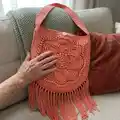
🧢 Beautiful ✨ Detailed πŸ’ Adorable

Delilah Boho Bag Pattern

Delilah Boho Bag Pattern
4.5β˜… Rating
8-10 Hours Time Needed
3.3K Made This
βœ‚οΈ

Intermediate Level

Ideal for those with basic crochet experience, featuring slightly more advanced stitches and techniques to expand your skills.

⏱️

All-Day Adventure

Requires 8-10 hours, ideal for a full day of immersive crocheting.

✨

Stylish Touch

An elegant detail to elevate any look, combining traditional techniques with contemporary design sensibilities.

About This Delilah Boho Bag Pattern

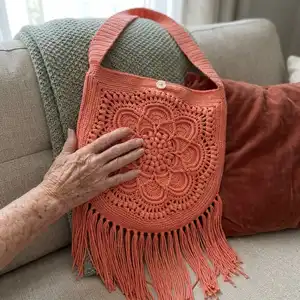
This pattern creates a boho-inspired shoulder bag featuring a large textured mandala panel, a reinforced top edge and a long fringe finish. You will work two identical panels, block them to size, join them, add a strap and sew in a lining. Special stitches include a chainless starting treble (CStr), popcorn (PC) and several front/back post stitches for lovely texture.

Delilah Boho Bag Pattern crochet pattern - detailed view of completed project

The pattern includes full round-by-round instructions with stitch counts and gauges, plus clear sewing and lining instructions. Photos and step notes explain tricky steps such as attaching the fringe and creating the button loop.

Why You'll Love This Delilah Boho Bag Pattern

I absolutely love this pattern because it combines a beautiful mandala motif with practical bag construction that really showcases textured crochet. I enjoy the challenge of mixing popcorns, front post treble and layered rounds to create depth. I also love that the finished bag is both stylish and useful, with a sewn lining and secure strap. Making the fringe is so satisfying β€” it gives the bag that perfect boho finish.

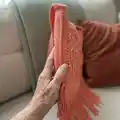
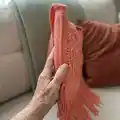
Delilah Boho Bag Pattern step 1 - construction progress Delilah Boho Bag Pattern step 2 - assembly progress Delilah Boho Bag Pattern step 3 - details and accessories Delilah Boho Bag Pattern step 4 - final assembly and finishing

Switch Things Up

I love changing colors to create different moods β€” try a two tone palette for the mandala and a neutral body for a subtle look.

If you want a smaller bag, switch to a finer yarn and smaller hook to create a mini version suitable for crossbody wear.

For a chunky, statement bag use DK or worsted weight yarn and a larger hook to make a bold oversized version.

I often add embroidered initials or a small crochet flower to the corner for personalization and extra charm.

Swap the long fringe for shorter tassels or leather fringe to change the overall style from boho to modern.

Try different lining fabrics β€” a printed satin gives a luxe finish while cotton is sturdier and easier to sew for beginners.

Adjust strap length to your preference; make it longer for a crossbody or shorter for a shoulder bag and remember the strap will stretch slightly when the bag is loaded.

Add a small inside pocket when making the lining to keep keys and phone secure and accessible.

Use a magnetic snap instead of a button loop for a cleaner closure and quicker access to the bag interior.

I sometimes add a chain detail woven through the top edge for a mixed-media look that stands out.

If you enjoy texture, experiment with more post stitches or raised popcorns in the outer rounds to create an even richer surface.

Make a matching set by crocheting a small pouch or sunglasses holder with the same motif and colorway.

Common Mistakes & How to Fix Them

βœ— Using a yarn with too much stretch will distort the bag shape over time; use 100% cotton or a cotton/acrylic blend as recommended to keep the bag stable. βœ— Skipping the chainless starting treble (CStr) at the start of treble rounds can create an uneven edge; practice the CStr or use ch2 then a regular tr into the stitch to maintain consistent height. βœ— Not blocking both motif panels to exactly the same size causes mismatched seams when joining; always wet or steam block both panels to the same measurements before joining. βœ— Attaching the strap with twists will make it hang awkwardly; lay the strap flat with no twists and pin carefully before slip stitching to the bag. βœ— Placing tassels or fringe inconsistently leads to an unbalanced look; measure and mark the placement (every 3rd stitch) and attach tassels evenly for a professional finish.

Delilah Boho Bag Pattern

Make a stylish Delilah Boho Bag with a textured mandala panel, neat top edge, sturdy strap and long fringe. This pattern guides you step-by-step through motif rounds, blocking, joining, strap and lining. Suitable for crocheters who enjoy texture, special stitches and a polished finished bag.

Intermediate 8-10 Hours

Materials Needed for Delilah Boho Bag Pattern

β€” Main Fabric

  • 01
    Sport/Baby/4ply yarn recommended (4ply), example: Bendigo Woollen Mills 4ply 100% cotton, 200g ball (180g/660yds used, approx. 1 ball)
  • 02
    If you prefer a larger bag use DK/Light Worsted/8ply yarn (quantity will vary)
  • 03
    100% cotton or cotton/acrylic blend recommended for stability and shape retention
  • 04
    Lining fabric: lightweight satin or cotton, amount depends on blocked bag size (fabric width = (bag width x2)+10cm, length = bag height +5cm)
  • 05
    Fringe yarn: additional yarn for 27 tassels (5 strands each) β€” cut 135 strands at 30cm (12in) each

β€” Tools Required

  • 01
    Crochet hook size 2.0mm (recommended for Sport/Baby/4ply)
  • 02
    Stitch markers
  • 03
    Yarn needle for weaving ends
  • 04
    Scissors (sharp)
  • 05
    Sewing needle and matching thread
  • 06
    Pins for blocking and assembly
  • 07
    2cm diameter button (for button loop)
  • 08
    Sewing machine (optional) for lining
  • 09
    Measuring tape or ruler
  • 10
    Iron for pressing fringe and lining adjustments

Progress Tracker

0% Complete

β€” Motif (Panel) :

Round 1 :

Magic ring. Ch1, 16dc into ring, slst in dc (16 dc)

Round 2 :

Ch1, *dc, ch2, skip 1 dc* x 8, slst in dc, slst in ch2 sp (8 dc, 8 ch2 sps)

Round 3 :

See Special Stitches for PC stitch. (PC, ch2) in each ch2 sp, slst in PC, slst in ch2 sp (8 PC, 8 ch2 sps)

Round 4 :

(PC, ch3, PC) in each ch2 sp, slst in PC, slst in ch2 sp (16 PC, 8 ch2 sps)

Round 5 :

*(PC, ch5, PC) in ch3 sp, tr between next 2 PC* x 8, slst in PC, slst in ch5 sp (16 PC, 8 tr, 8 ch5 sps)

Round 6 :

*9tr in ch5 sp, FPdtr around tr* x 8, slst in tr (72 tr, 8 FPdtr)

Round 7 :

Ch1, *BPdc x 9, (FPdtr, ch3, FPdtr) around FPdtr* x 8, slst in BPdc (Stitch counts are per side for rounds 7-17: 9 BLdc, 2 FPdtr, 1 ch3 sp)

Round 8 :

Ch1, *dc x 9, FPtr around FPdtr, 5tr in ch3 sp, FPtr around FPdtr* x 8, slst in dc, slst in next dc (9 dc, 2 FPtr, 5 tr)

Round 9 :

Ch1, *dc x 7, skip 1 dc, FPtr, 2BLtr x 5, FPtr, skip 1 dc* x 8, slst in dc, slst in next dc (7 dc, 2 FPtr, 10 BLtr)

Round 10 :

Ch1, *dc x 5, skip 1 dc, FPtr, [2tr, tr] x 5, FPtr, skip 1 dc* x 8, slst in dc, slst in next dc (5 dc, 2 FPtr, 15 tr)

Round 11 :

Ch1, *dc x 3, skip 1 dc, FPtr, [tr x 2, 2tr] x 5, FPtr, skip 1 dc* x 8, slst in dc, slst in next dc (3 dc, 2 FPtr, 20 tr)

Round 12 :

Ch1, *dc, skip 1 dc, FPtr, BPdc x 20, FPtr, skip 1 dc* x 8, slst in dc, slst in FPtr, slst in BPdc (1 dc, 2 FPtr, 20 BPdc)

Round 13 :

*tr x 20, FPtr2tog using next 2 FPtr (skipping dc)* x 8, slst in tr, slst in next 3 tr (20 tr, 1 FPtr2tog)

Round 14 :

Replace the first BPtr of the round with (BPdc, ch2). Ch1, *[BPtr, ch1] x 14, BPtr6tog using next 6 tr (skipping tr2tog), ch1* x 8, slst in top ch2, slst in ch1 space (14 BPtr, 1 BPtr6tog, 15 ch1 sps)

Round 15 :

Mark the 3rd dc in each set. Ch1, *dc in ch1 sp, 2dc in next 11 ch1 sps, dc in ch1 sp, skip BPtr, skip ch1 sp, skip BPtr6tog, skip ch1 sp, skip BPtr* x 8, slst in dc, slst in next 4 dc (24 dc)

Round 16 :

*[tr, ch2, skip 1 dc] x 9, tr2tog using next dc and next marked stitch, ch2* x 8, replace last ch2 with tr in first tr (9 tr, 10 ch2 sps, 1 tr2tog)

Round 17 :

First PC goes into the sp created by the joining tr. Note that there is no chain space between the 2 PC either side of the tr2tog. *[PC in ch2 sp, ch3] x 9, PC in ch2 sp, skip tr2tog* x 8, slst in PC. Fasten off. (10 PC, 9 ch3 spaces)

Info :

Fasten off after Round 17. Repeat the pattern to create a second identical panel. Block both panels to the same size before continuing.

Round 18 :

Attach yarn to the 5th space of any 'petal'. There is no ch3 space between the 2 PC either side of the tr2tog. Skip all PC. I have broken this round down into steps to make it easier to understand. 3tr in next 6 ch3 sps (photo 18a), *3htr in next ch3 sp, 3dc in next 5 ch3 sps, 3htr in next ch3 sp, 3tr in next 2 ch3 sps* x 5 (photo 18b), 3tr in next 3 ch3 sps, (3tr, ch2, 3tr) in next ch3 space (photo 18c), 3tr in next 5 ch3 sps, 3htr in next ch3 sp, 3dc in next 5 ch3 sps (photo 18d), 3htr in next ch3 sp, 3tr in next 5 ch3 sps, 3tr in first ch3 sp, ch1, dc in first tr (counts as ch2 sp) (photo 18e) (Total counts for rounds 18-21: 96 tr, 36 htr, 90 dc, 2 ch2 sps)

Round 19 :

3tr into space created by joining dc, tr x 18, htr x 3, *dc x 15, htr x 3, tr x 6, htr x 3* x 4, dc x 15, htr x 3, tr x 18, (3tr, ch2, 3tr) in ch2 space, tr x 15, htr x 6, dc x 15, htr x 6, tr x 15, 3tr in first space, ch1, dc in first tr (102 tr, 42 htr, 90 dc, 2 ch2 sps)

Round 20 :

3tr into space created by joining dc, tr x 21, htr x 3, dc x 15, htr x 3, tr x 87, htr x 3, dc x 15, htr x 3, tr x 21, (3tr, ch2, 3tr) in ch2 space, tr x 18, htr x 3, dc x 21, htr x 3, tr x 18, 3tr into first space, ch1, dc in first tr (177 tr, 18 htr, 51 dc, 2 ch2 sps)

Round 21 :

3tr in sp created by joining dc (mark first tr), tr x 177, 5tr in ch2 sp (mark 3rd tr), tr x 69, 2tr in first sp, slst in tr. Fasten off. (256 tr)

β€” Blocking :

Info :

Blocking will give a neat, flat, even look and help maintain the correct shape. Dip or spray with clean water, gently squeeze excess, pin to desired shape on blocking boards or foam mats and allow to dry completely. Block both panels to the same final size (example: 32cm x 32cm / 12.6in x 12.6in used by designer).

β€” Joining panels together :

Info :

With the wrong sides of the panels facing each other and the corners aligned, attach yarn to the left-hand marked stitches of both panels. Ch1, dc in corresponding stitches of both panels all the way around the curved edge, stopping at the right-hand corner marked stitch. 183 dc. Do not fasten off; continue on to the top edge.

β€” Top Edge :

Round 1 :

Mark the first st of each round. Ch1, dc x 73 starting with the next tr, dc in the first dc of the joining row, dc x 37, ch20 (button loop), dc x 36, dc in the last dc of the joining row (148 dc, 1 ch20)

Round 2 :

Dc x 148 (moving the button loop to the outside of the bag) (148 dc)

Round 3 :

Dc x 143 (finishing with 5 stitches left). Do not fasten off, continue on to the strap. (143 dc)

β€” Strap :

Row 1 :

Ch2 at the start of the row does not count as a stitch. Ch2, tr in same stitch as last dc, tr x 11, turn (12 tr)

Rows 2-61 :

Ch2, tr in first tr, tr x 11, skip ch2, turn. Approximately 60cm (24in) long. (12 tr)

Info :

With no twists in the strap, place the right side of the strap against the right side of the bag. Ch1, slst the strap to the bag with 6 slst either side of the seam. Fasten off and weave in the ends.

β€” Lining (Sewing) :

Info :

Basic sewing knowledge assumed. Supplies: crochet bag, paper bigger than the bag, pencil, ruler, scissors, pins, lining fabric, thread to match, sewing machine. Choose a non‑stretch fabric (satin or cotton recommended). Width of fabric = (bag width x 2) + 10cm. Length = bag height + 5cm.

Pattern (make template) :

1. Fold strap to back, place bag on paper and press flat. Mark top edge where strap joins bag and draw around curve. 2. Remove bag and draw straight line joining the marks at the top edge. 3. Add 2cm above the red line and 1cm around the curved edge. 4. Fold pattern in half sideways to create symmetrical shape and draw grainline along fold.

Cutting :

Pin pattern onto fabric with selvedge parallel to grainline. Double fabric if you want two pieces; cut two pieces if necessary. If doubled, one cut gives two pieces.

Sewing :

With right sides facing each other, sew around curved edge with 1cm (0.4in) seam allowance. Press seam flat and topstitch. Fold top edge over 1cm then again 1cm and sew close to the first fold to create a neat hem.

Attach lining :

Fold the button loop down and secure it. Place the lining inside the bag with right side facing inwards and align side seams. Pin the lining just below the top edge adjusting the crochet to fit. Sew close to fold, being careful not to sew the button loop or straps. Fasten off and trim threads.

β€” Fringe :

Info :

Cut 135 strands of yarn at 30cm (12in) each (27 tassels with 5 strands each = 135 strands). Attach the first tassel to the 53rd dc of the joining row. Fold 5 strands in half, place hook through indicated stitch from back to front, place folded end over hook and pull through, yarn over with strands, pull through loop and tighten. Repeat for remaining strands every 3rd stitch around bottom curve to create 27 tassels. Iron fringe and trim ends as needed.

Assembly Instructions

  • After making two identical motif panels, block both panels to the same measurements before joining to ensure edges align correctly.
  • With wrong sides together join the two panels by dc through both layers around the curved edge, stopping at the marked right-hand corner (183 dc) and do not fasten off before working the top edge.
  • Create the button loop during the top edge rounds by making ch20 at the top centre, then work the top edge rounds, moving the loop to the outside of the bag so it sits neatly when fastened.
  • Work the strap flat in rows (approx. 60cm / 24in long), ensuring there are no twists; align and slip stitch the strap to the bag with 6 slst on either side of the seam for a secure attachment.
  • Sew the lining separately: cut fabric to (width = (w x2)+10cm, length = h+5cm), sew curved seam with 1cm allowance, turn and topstitch, then pin and sew the lining into the bag close to the top fold, avoiding the button loop and straps.
  • Attach the fringe tassels evenly: fold 5 strands, attach with a hook or latch method into every 3rd stitch starting at the 53rd dc; space tassels evenly to achieve 27 tassels and trim to even the length.

Important Notes

  • πŸ’‘Use stitch markers to mark the start of rounds and key spaces such as ch3 spaces used later for placement of larger clusters.
  • πŸ’‘When working special stitches like CStr and PC, practice on a swatch first to ensure consistent height and tension for a neat join between rounds.
  • πŸ’‘Block both motif panels to the same dimensions before joining; inconsistent blocking is the most common cause of mismatched seams.
  • πŸ’‘Work with even tension and check stitch counts at the end of each round to avoid drift later in the pattern.

This Delilah Boho Bag pattern gives you a beautiful bohemian accessory to cherish and wear every day. The textured mandala panel, tidy top edge and long fringe make it uniquely stylish and handmade. Enjoy the process and the lovely finished bag you created with care and patience. 🧢✨

You ask,

we answer.

FAQs

What size will the finished bag be?

The finished bag measures approximately 32cm x 32cm (12.6in x 12.6in) for each blocked panel when using Sport/Baby/4ply cotton and the recommended hook size.

Can I use a different yarn weight or hook size?

Yes, you can use a different yarn weight, but the finished size and stitch counts will vary; switching to DK/light worsted will produce a larger bag β€” adjust hook size and yarn quantities accordingly.

What skill level is required for this pattern?

This pattern is rated Intermediate β€” you should be comfortable with basic stitches, working in rounds, and comfortable learning special stitches like the chainless starting treble (CStr) and popcorn (PC).

How long does this project take to complete?

Most crocheters complete the project in 8-10 hours; time varies based on experience and how much sewing/lining and fringe work you include.