🧢 Beautiful ✨ Detailed πŸ’ Adorable

Spring Teapot House Amigurumi Pattern

Spring Teapot House Amigurumi Pattern
4.0β˜… Rating
8-10 Hours Time Needed
2.6K Made This
βœ‚οΈ

Intermediate Level

Ideal for those with basic crochet experience, featuring slightly more advanced stitches and techniques to expand your skills.

⏱️

All-Day Adventure

Requires 8-10 hours, ideal for a full day of immersive crocheting.

🧸

Cute Companion

An adorable friend to cherish, handcrafted with love to bring comfort and joy for years to come.

About This Spring Teapot House Amigurumi Pattern

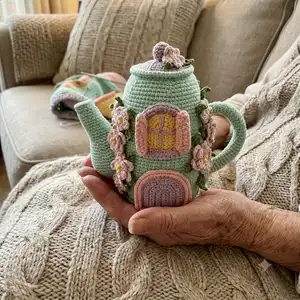
This pattern creates a sweet teapot-shaped house amigurumi with a removable lid, a spout, a wired handle and charming windows and shutters. You will shape the rounded teapot body, crochet a curved spout and make small decorative pieces like a door, windows and flowers. The pattern uses small-gauge yarn and a 2.25 mm hook for tight stitches and neat shaping.

Spring Teapot House Amigurumi Pattern crochet pattern - detailed view of completed project

Detailed round-by-round instructions and photos are included to help you assemble each piece accurately. The finished toy measures about 18.5 cm tall using the recommended yarn.

Why You'll Love This Spring Teapot House Amigurumi Pattern

I absolutely love this pattern because it brings together shaping techniques and tiny decorative details that make a simple teapot feel like a magical little house. I enjoy how the windows and shutters let you play with color combinations and create personality for each teapot. The wired handle gives a nice structure and makes the finished piece feel sturdy and handmade in the best way. Working this pattern always makes me smile β€” the flowers and door are such fun finishing touches.

Spring Teapot House Amigurumi Pattern step 1 - construction progress Spring Teapot House Amigurumi Pattern step 2 - assembly progress Spring Teapot House Amigurumi Pattern step 3 - details and accessories Spring Teapot House Amigurumi Pattern step 4 - final assembly and finishing

Switch Things Up

I love how easily you can change the look of this teapot by swapping yarn colors β€” try pastel shades for a soft nursery look or brighter tones for a playful shelf display.

You can make a mini keychain version by using fingering yarn and a smaller hook to create a tiny teapot in the palm of your hand.

Want a chunkier, more tactile teapot? Use bulky yarn and a larger hook for a cozy, huggable version that makes a great pillow of a decorative piece.

I often add embroidery details like tiny flowers or gold thread edging to give the teapot an extra hand-finished touch that really pops.

For a seasonal set, make matching lids and trim in holiday colors, or create a whole tea set of cups and a tray using the same yarn palette.

Try substituting a thin wire instead of chenille for a firmer handle frame if you want a sleeker finish with less bulk inside the handle.

I sometimes replace the plastic base with a round piece of cork for a natural, lightweight option that still gives good stability.

Make the door removable by attaching it with a few snap fasteners or a small button so the teapot can act as a tiny playhouse for dolls.

Experiment with adding beads to the flower centers or sewing on tiny buttons as doorknobs to personalize each piece I make.

Don't be afraid to mix yarn brands: try a cotton blend for a crisper finish or a soft acrylic for a plush look β€” just check your gauge before you commit to a new yarn.

Common Mistakes & How to Fix Them

βœ— Skipping a stitch marker when working in continuous rounds will make rounds hard to identify; place a marker at the first stitch of each round to keep your counts accurate. βœ— Not stuffing gradually will create lumps or flattening in rounded sections; add stuffing little by little, especially when shaping narrow parts like the spout. βœ— Using a loose gauge will make the teapot floppy and the stuffing show through; use the recommended hook or go down a hook size to keep stitches tight. βœ— Forgetting to secure the plastic base will affect stability; cut a plastic circle to fit and glue it to the wrong side of the bottom before closing the base.

Spring Teapot House Amigurumi Pattern

Make a charming Spring Teapot House amigurumi that doubles as a whimsical decorative toy. This pattern guides you through shaping the teapot body, spout, handle and the sweet door and windows with clear step-by-step photos. You will enjoy creating delicate flowers and shutters to give your teapot its springtime personality.

Intermediate 8-10 Hours

Materials Needed for Spring Teapot House Amigurumi Pattern

β€” Main Fabric

  • 01
    Yarn Art Jeans (55% cotton, 45% acrylic, 160 m/50 g) Mint 79 - a little more than 1 skein (main color)
  • 02
    Yarn Art Jeans Lilac 19 - small quantity for lid and trims
  • 03
    Yarn Art Jeans Light Yellow 88 - small amount for window interior
  • 04
    Yarn Art Jeans Light Pink 18 - small amount for shutters/flowers
  • 05
    Yarn Art Jeans Green 69 - very small amount for leaves/vines
  • 06
    Yarn Art Jeans Brown 40 - small amount for details
  • 07
    Alize Cotton Gold Hobby (55% cotton, 45% acrylic, 165 m/50 g) Pink 393 - small quantity for accents
  • 08
    Synthetic fiberfill for stuffing
  • 09
    Chenille wire (pipe cleaners) - 4 pcs of 30 cm long for handle armature
  • 10
    A piece of hard plastic (e.g. thick plastic folder or cutting board) for the base reinforcement

β€” Tools Required

  • 01
    Crochet hook size 2.25 mm (hook size may vary depending on your crocheting gauge)
  • 02
    Big-eyed needle for sewing pieces
  • 03
    Hot glue gun
  • 04
    Scissors
  • 05
    Water erasable marker
  • 06
    Sewing pins
  • 07
    Stitch markers
  • 08
    Polyester stuffing (fiberfill)
  • 09
    A piece of hard plastic (for example a piece of thick plastic paper folder or cutting board)
  • 10
    Chenille wire (pipe cleaners) 4 pcs of 30 cm long

Progress Tracker

0% Complete

β€” Body :

Info :

Start crocheting from the teapot bottom with mint yarn. Use a piece of yarn of contrasting color as a marker for easy rounds counting.

Round 1 :

6 sc in AR (6)

Round 2 :

inc*6=12 sc (12)

Round 3 :

(1 sc, inc)*6=18 sc (18)

Round 4 :

1 sc, inc, (2 sc, inc)*5, 1 sc=24 sc (24)

Round 5 :

(3 sc, inc)*6=30 sc (30)

Round 6 :

2 sc, inc, (4 sc, inc)*5, 2 sc=36 sc (36)

Round 7 :

(5 sc, inc)*6=42 sc (42)

Round 8 :

3 sc, inc, (6 sc, inc)*5, 3 sc=48 sc (48)

Round 9 :

(7 sc, inc)*6=54 sc (54)

Round 10 :

4 sc, inc, (8 sc, inc)*5, 4 sc=60 sc (60)

Round 11 :

(9 sc, inc)*6=66 sc (66)

Round 12 :

5 sc, inc, (10 sc, inc)*5, 5 sc=72 sc (72)

Round 13 :

(11 sc, inc)*6=78 sc (78)

Round 14 :

6 sc, inc, (12 sc, inc)*5, 6 sc=84 sc (84) Finish with a sl st, do not cut the yarn.

Info :

Cut out from plastic a circle according to the size of crocheted detail and glue it on the wrong side. I used a leftover of hard plastic canvas for it.

Round 15 :

84 sc through the back loops (84)

Rounds 16-24 :

9 rounds of 84 sc (84)

Round 25 :

(12 sc, dec)*6=78 sc (78)

Rounds 26-34 :

9 rounds of 78 sc (78)

Round 35 :

(11 sc, dec)*6=72 sc (72)

Rounds 36-43 :

8 rounds of 72 sc (72)

Round 44 :

(10 sc, dec)*6=66 sc (66)

Rounds 45-50 :

6 rounds of 66 sc (66)

Round 51 :

(9 sc, dec)*6=60 sc (60)

Round 52 :

60 sc (60)

Round 53 :

(8 sc, dec)*6=54 sc (54)

Round 54 :

(7 sc, dec)*6=48 sc (48)

Info :

Stuff.

Round 55 :

Change yarn to lilac, sc 48 through the back loops (48)

Round 56 :

48 sc through both loops (48)

Round 57 :

(6 sc, dec)*6=42 sc (42)

Round 58 :

(5 sc, dec)*6=36 sc (36)

Round 59 :

(4 sc, dec)*6=30 sc (30)

Round 60 :

(3 sc, dec)*6=24 sc (24)

Round 61 :

(2 sc, dec)*6=18 sc (18)

Round 62 :

(1 sc, dec)*6=12 sc (12)

Round 63 :

Dec every st until the opening closes (add fiberfill if necessary). Cut the yarn and fix the end.

Info :

Join the mint yarn to the 54th round and crochet through the front loops: 3 sc, inc, (7 sc, inc)*5, 4 sc = 54 sc.

Round 64 :

Crochet 2 rounds more of 54 sc each. Finish with a sl st, leave a long end.

Info :

Thread the end of the yarn into the needle. Fold the edge inward and stitch around.

Info :

Join lilac yarn to the bottom line and sl st through the front loops.

Round 65 :

Sc 1 round through the back loops of sl st.

Round 66 :

Sl st one more round. Cut the yarn and fix the end.

β€” Spout :

Round 1 :

6 sc in AR (6)

Round 2 :

inc*6=12 sc (12)

Round 3 :

(1 sc, inc)*6=18 sc (18)

Info :

Crochet one more sc after the last inc and finish with a sl st. Do not cut the yarn.

Round 4 :

18 sc through the back loops (18)

Rounds 5-7 :

18 sc (18)

Round 8 :

inc, 17 sc = 19 sc (19)

Round 9 :

2 sc, inc, 16 sc = 20 sc (20)

Round 10 :

2 sc, inc, 17 sc = 21 sc (21)

Round 11 :

2 sc, inc, 18 sc = 22 sc (22)

Round 12 :

2 sc, inc, 19 sc = 23 sc (23)

Round 13 :

2 sc, inc, 20 sc = 24 sc (24)

Round 14 :

24 sc (24)

Round 15 :

(3 sc, inc)*6=30 sc (30)

Rounds 16-17 :

30 sc (30)

Round 18 :

(4 sc, inc)*6=36 sc (36)

Rounds 19-20 :

36 sc (36)

Round 21 :

(5 sc, inc)*6=42 sc (42)

Rounds 22-23 :

42 sc (42)

Round 24 :

(6 sc, inc)*6=48 sc (48)

Rounds 25-27 :

48 sc (48)

Round 28 :

(6 sc, dec)*6=42 sc (42)

Round 29 :

(5 sc, dec)*6=36 sc (36) Stuff the narrow part tightly and the wide part looser.

Round 30 :

(4 sc, dec)*6=30 sc (30)

Round 31 :

(3 sc, dec)*6=24 sc (24)

Round 32 :

(2 sc, dec)*6=18 sc (18)

Round 33 :

(1 sc, dec)*6=12 sc (12)

Round 34 :

dec*6. Cut the yarn and fix the end.

Info :

Join yarn to the 3d round and sc 18 through the front loops.

Info :

Crochet one more round of 18 sc and the last one 18 sl st. Cut the yarn and fix the end.

Info :

The spout needs to be attached to the teapot so that the marker on the first rows looks at the teapot.

Info :

Slightly flatten the lower wide part of the spout and attach to the teapot with pins.

Info :

Start sewing from the lower center point, gradually removing the pins. Neatly sew around.

β€” Handle :

Info :

For handle sc 6 in AR, inc*6 in the second round.

Info :

Then crochet spiral rounds up without inc.

Info :

Put 4 chenille wires together, fold in half and twist them together. Crochet the handle of the fitting length.

Info :

Put the wire inside and sew the opened end with the end of the yarn.

Info :

Bend the flat end of the handle and sew to the teapot. Sew the second end close to the bottom.

β€” Lid and Lid Handle :

Info :

Crochet the lid handle with lilac yarn:

Round 1 :

6 sc in AR (6)

Round 2 :

inc*6=12 sc (12)

Rounds 3-4 :

2 rounds of 12 sc. Stuff. (12)

Round 5 :

dec*6, cut the yarn, leave a long end.

Info :

Sew to the lid with the end of the yarn.

β€” Door :

Info :

Crochet door with lilac yarn. Chain 10, crochet U-shaped rows with a turning ch in the beginning of every row.

Row 1 :

8 sc, 3 inc in the last loop, 8 sc along the bottom side of the chain = 19 sc.

Row 2 :

8 sc, inc*3, 8 sc = 22 sc.

Row 3 :

8 sc, (1 sc, inc)*3, 8 sc = 25 sc.

Row 4 :

8 sc, (2 sc, inc)*3, 8 sc = 28 sc.

Row 5 :

8 sc, (3 sc, inc)*3, 8 sc = 31 sc.

Row 6 :

8 sc, (4 sc, inc)*3, 8 sc = 34 sc.

Row 7 :

Change yarn to the pink, crochet through the back loops: 8 sc, (5 sc, inc)*3, 8 sc = 37 sc.

Row 8 :

Crochet through the back loops 37 sc.

Rows 9-10 :

2 more rows of 37 sc through both loops. Leave a long end.

Info :

Thread the end of the pink yarn into the needle. Fold the pink part in half (outwards) and sew the edge to the front loops of the 7th row.

Info :

Join the pink yarn to the bottom side of the door and sc 7 rows of 13 sc. Leave a long end.

Info :

Roll the pink part inwards and sew with the end of the yarn. Sew the corners. Sew to the window (see assembly).

β€” Window :

Info :

Crochet window with light yellow yarn. Chain 8, crochet like the door U-shaped rows.

Row 1 :

6 sc, 3 sc in the last loop, 6 sc along the bottom side of the chain = 15 sc.

Row 2 :

6 sc, inc*3, 6 sc = 18 sc.

Row 3 :

6 sc, (1 sc, inc)*3, 6 sc = 21 sc.

Row 4 :

6 sc, (2 sc, inc)*3, 6 sc = 24 sc.

Row 5 :

Change yarn to the lilac, crochet through the back loops: 6 sc, (3 sc, inc)*3, 6 sc = 30 sc.

Row 6 :

30 sc through the back loops.

Rows 7-8 :

2 rows of 30 sc through both loops. Leave a long end.

Info :

Fold the lilac part outwards and sew. Sc 4 rows of 10 sc with lilac yarn along the bottom side of the window.

Info :

Fold inwards, sew with the end of the yarn. Sew the corners. Stitch a cross-shaped frame on the window.

β€” Shutters :

Info :

Crochet the shutters in pink: make 2 pcs like light yellow parts of the window. Leave long ends.

Info :

Fold in half and sew all the opened sides over the edge. Sew to the window.

Info :

Make another window, change the colors of the frame and the shutter in places. Attach the second window at the opposite side of the teapot.

β€” Flowers :

Info :

Crochet the flowers with light pink yarn: Chain 5, close into the ring with a sl st.

Petal :

Crochet in the ring (not into every loop) 2 ch, 2 dc, 2 ch, sl st – it should be one petal. Repeat to make petals for each flower.

β€” Assembly :

Info :

Glue or sew the door and one window above it.

Info :

Attach the second window at the opposite side of the teapot.

Info :

Glue or sew flowers and leaves around the windows and attach small vines, sew shutters in place and add embroidered window frames.

Info :

Sew the lid handle to the lid. Place the lid on the teapot. Finish by weaving in ends and trimming stray yarn.

Assembly Instructions

  • Attach the spout so the marker on the first rows faces the teapot and sew starting from the lower center point, gradually removing pins as you go for a neat seam.
  • Slightly flatten the lower wide part of the spout when sewing and stuff the spout with firmer stuffing in the narrow end and softer stuffing toward the body before closing.
  • Insert the twisted chenille wire armature into the crocheted handle tube, sew the opened end closed with yarn, bend the flat end and sew one end near the top and the second end close to the teapot bottom for stability.
  • Glue or sew the door at the front and one window above it; attach the second window on the opposite side of the teapot, then sew shutters and add the small window frame by stitching a cross shape over the window center.
  • Sew or glue decorative flowers and leaves in place, fastening each with a few stitches or a drop of hot glue as needed; weave in all ends and ensure the plastic base is glued on the inside for stability.

Important Notes

  • πŸ’‘Use a contrasting yarn as a stitch marker at the start of rounds to help you count and keep track of rounds easily.
  • πŸ’‘Stuff gradually and more firmly in narrow parts like the spout and less firmly in wide parts for natural shaping; overstuffing can distort the shape.
  • πŸ’‘Cut a circle from hard plastic and glue it to the wrong side of the bottom before finishing the base to stabilize the teapot and keep the bottom flat.
  • πŸ’‘When making the handle, twist four chenille wires together, fold and crochet around them, then insert and sew the opened end closed to secure the wire inside.
  • πŸ’‘Work with tight tension using the recommended 2.25 mm hook to avoid gaps where stuffing could show through, especially using light yarn.

This delightful Spring Teapot House amigurumi is a perfect gift or a charming display piece for your home. The pattern includes step-by-step rounds and clear assembly tips so you can recreate every tiny detail with confidence. Enjoy making the cozy door, windows, shutters, and delightful flowers that bring this miniature house to life. 🧢🌸

You ask,

we answer.

FAQs

What size will the finished piece be?

The height of the finished toy from recommended yarn is about 18.5 cm when using the specified yarn and hook size.

Can I use different yarn weights for this pattern?

Yes, you can use different yarn weights, but that will change the final size and the number of stitches per round; adjust your hook size accordingly and make a gauge test.

Do I need special materials like wire or plastic?

Yes, the pattern uses four chenille wires (pipe cleaners) twisted together for a wired handle and a piece of hard plastic to reinforce the bottom for stability.

How long does this project typically take to complete?

Most crocheters complete this project in 8-10 hours, though time may vary based on experience level and how many decorative details you add.