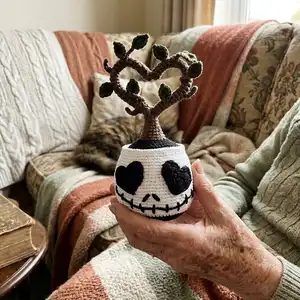
🧢 Beautiful ✨ Detailed πŸ’ Adorable

Jack in Love Amigurumi Pattern

Jack in Love Amigurumi Pattern
4.8β˜… Rating
5-7 Hours Time Needed
1.1K Made This
βœ‚οΈ

Intermediate Level

Ideal for those with basic crochet experience, featuring slightly more advanced stitches and techniques to expand your skills.

⏱️

Weekend Treat

Takes 5-7 hours, making it an enjoyable project to finish over a couple of days.

🧸

Cute Companion

An adorable friend to cherish, handcrafted with love to bring comfort and joy for years to come.

About This Jack in Love Amigurumi Pattern

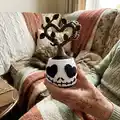
This pattern makes a decorative skull-shaped pot with a heart-shaped tree growing from inside, complete with leaves and embroidered facial details. It uses fine/sport weight yarn and includes shaping, color changes, and wire insertion to make posable branches. The instructions are photo-assisted and explain invisible decreases, FLO/BLO techniques, and finishing steps so you can recreate the exact look.

Jack in Love Amigurumi Pattern crochet pattern - detailed view of completed project

You will crochet the base, soil, stem, two branches shaped into a heart, separate leaves and eyes, then assemble and embroider the facial features. The pattern includes yarn suggestions, tools, and helpful tips for a polished finish.

Why You'll Love This Jack in Love Amigurumi Pattern

I absolutely love this pattern because it combines character and decor in one charming piece that brings joy to any shelf. I love the mix of techniques β€” shaping a pot, working invisible decreases, and creating a posable heart-shaped tree β€” which keeps the work interesting from start to finish. The small scale and detailed finishing (embroidery and sewn leaves) make each finished piece feel very special and gift-ready. I also enjoy how customizable it is: you can change colors and leaf placement to create endless variations.

Jack in Love Amigurumi Pattern step 1 - construction progress Jack in Love Amigurumi Pattern step 2 - assembly progress Jack in Love Amigurumi Pattern step 3 - details and accessories Jack in Love Amigurumi Pattern step 4 - final assembly and finishing

Switch Things Up

I love customizing this design by changing yarn colors and yarn weights to get different moods β€” try pastel shades for a softer, romantic look or deep jewel tones for a spooky-chic vibe.

You can make the piece larger or smaller by changing your yarn and hook: use thicker yarn and a bigger hook for a chunky, cuddly version or thinner yarn for a delicate mini keychain-sized version.

I often swap the heart-shaped tree for other shapes by altering the branch length and curvature; you can experiment with three branches instead of two for a fuller tree.

Try using metallic or variegated yarn for the leaves to add shimmer and visual interest β€” tiny beads or French knots also make pretty leaf details.

For a posable tree, use a thicker or double-wrapped wire and wrap it inside the branch to keep it in place; copper wire is great because it bends easily and stays in shape.

Change the facial expression by moving the eyes or adjusting the mouth embroidery; a wider smile or closed eyes gives a completely different personality.

Make a set of matching pots in coordinated colors for a shelf display or a series of seasonal versions (spring pastels, autumn warm tones, Halloween contrasts).

I like to add small accessories like a tiny crocheted scarf or a miniature sign stuck into the soil for personalization and gift presentation.

Experiment with stuffing density to alter the pot shape β€” firmer stuffing gives structure while softer stuffing gives a squishier, handcrafted look.

Finally, don’t be afraid to mix yarn brands: use a sturdier cotton for the pot and a softer acrylic for the tree to balance stability and texture in the finished piece.

Common Mistakes & How to Fix Them

βœ— Skipping the stitch marker while working continuous spirals leads to lost rounds; use a stitch marker and move it at the end of each round to stay on track. βœ— Stuffing too early or unevenly causes lumps and misshaped parts; stuff gradually and firmly between shapings to maintain smooth contours. βœ— Not changing colors on the correct yarn-over can create messy joins; change color on the second half of the last stitch as instructed to keep a neat edge. βœ— Forgetting to crochet into the correct loops (FLO/BLO) causes mismatched joins later; carefully follow the FLO/BLO notes and mark the chain loops if needed to avoid mistakes.

Jack in Love Amigurumi Pattern

Create a charming Jack-in-Love amigurumi: a skull-shaped pot with a heart-shaped tree growing from the soil. This pattern guides you step-by-step through crocheting the base, soil, stem, branches, leaves, and heart-shaped tree with clear instructions and photos. You will learn shaping, invisible decreases, front/back loop techniques, color changes, and simple embroidery to bring the face to life. Perfect as a decorative gift or desk companion.

Intermediate 5-7 Hours

Materials Needed for Jack in Love Amigurumi Pattern

β€” Main Fabric

  • 01
    Sport weight yarn (Fine yarn) for cotton+acrylic or Fingering (Super fine yarn) for 100% cotton yarn
  • 02
    Colors: white (approx. 20g)
  • 03
    black (approx. 15g)
  • 04
    brown (approx. 10g)
  • 05
    green (approx. 5g)
  • 06
    Yarn Art Jeans (50g/160m, 55% Cotton, 45% Acrylic): black - #53 (bottom of base, soil, eyes, mouth, nose); green - #82 (leaves); brown - #40 (tree)
  • 07
    Alize Cotton Gold (100g/330m, 55% cotton 45% polyacrylic): white - #55 (pot)

β€” Tools Required

  • 01
    Crochet hook size 2 mm Clover Amour (used by designer; corresponds to approx. 1.75 mm regular crochet hook)
  • 02
    Crochet hook size 2.25 mm Clover Amour (used in testing sample)
  • 03
    Scissors
  • 04
    Tapestry needle for sewing and embroidery
  • 05
    Pins for positioning parts
  • 06
    Stitch marker (a piece of yarn is fine)
  • 07
    Polyester stuffing (fiberfill)
  • 08
    Stuffing tool (wooden skewers and tweezers recommended)
  • 09
    Wire 2 mm (approximately 60 cm, copper recommended for stability and bendability)
  • 10
    A small piece of plastic to fit the bottom (e.g., lid of a plastic container)

Progress Tracker

0% Complete

β€” Base :

Info :

Work with black yarn.

Round 1 :

6 sc in a MR (6)

Round 2 :

6 inc (12)

Round 3 :

(inc, 1 sc) * 6 (18)

Round 4 :

(inc, 2 sc) * 6 (24)

Round 5 :

(inc, 3 sc) * 6 (30)

Round 6 :

2 sc, (inc, 4 sc) * 5, inc, 2 sc (36)

Round 7 :

(inc, 5 sc) * 6 (42)

Round 8 :

3 sc, (inc, 6 sc) * 5, inc, 3 sc (48)

Round 9 :

(inc, 7 sc) * 6 (54)

Round 10 :

4 sc, (inc, 8 sc) * 5, inc, 4 sc (60)

Info :

Change to white color (fasten off black yarn).

Round 11 :

BLO (p.8) 60 sc (60)

Round 12 :

(inc, 9 sc) * 6 (66)

Round 13 :

66 sc (66)

Round 14 :

5 sc, (inc, 10 sc) *5, inc, 5 sc (72)

Round 15 :

72 sc (72)

Round 16 :

(inc, 11 sc) * 6 (78)

Round 17-21 :

(5 rows) 78 sc (78)

Round 22 :

(dec, 11 sc) * 6 (72)

Round 23-25 :

(3 rows) 72 sc (72)

Round 26 :

5 sc, (dec, 10 sc) * 5, dec, 5 sc (66)

Round 27-30 :

(4 rows) 66 sc (66)

Info :

Cut out a piece of plastic to fit the bottom (it will help to make the base steady) and put it inside the base (as shown in the p.9). If your plastic is too flexible, cut out 2 or 3 pieces and put them together.

Round 31 :

FLO 66 sc (p.10) (66)

Round 32 :

66 sc (p.11) (66)

Info :

Cut the yarn off leaving a tail 15-20 cm to weave in the end. Use the "straight edge" method (see the next page for instructions).

β€” Top (Soil) :

Info :

Attach black yarn to the back loop of 30th round (p.15). Make regular decreases in the next round instead of invisible ones as described (pull a loop through one stitch, pull a loop through the next stitch (p.16), yarn over, pull through 3 loops on the hook (p.17)).

Round 1 :

(dec, 9 sc) * 6 (60)

Round 2 :

4 sc, (dec, 8 sc) * 5, dec, 4 sc (54)

Round 3 :

(dec, 7 sc) * 6 (48)

Round 4 :

(dec, 6 sc) * 6 (42)

Round 5 :

(dec, 5 sc) * 6 (36)

Round 6 :

(dec, 4 sc) * 6 (30)

Info :

Stuff the base firmly.

Round 7 :

(dec, 3 sc) * 6 (24)

Info :

Change to brown color (fasten off black yarn).

Round 8 :

FLO 24 sc (24)

Round 9 :

(dec, 2 sc) * 6 (18)

Round 10-11 :

(2 rounds) 18 sc (18)

Round 12 :

(dec, 1 sc) * 6 (12)

Round 13-16 :

(4 rounds) 12 sc (12)

Info :

Stuff the stem. From the next round, we will start to make branches.

Round 17 :

6 sc, ch 2 (8)

Info :

Continue crocheting the next round starting from the 1st stitch of the previous round (p.20). Mark the 2nd of 2 chains (p.21 - red loop), we will need it while crocheting the second branch.

Round 18 :

6 sc, 2 sc along the chain, make sure to crochet only into BLO of the chain (p.21 - white loops), as we will need the front loops (red and yellow) to crochet the second branch (p.22).

Round 19-27 :

(9 rounds) 8 sc (8)

Round 28 :

dec, 6 (7)

Round 29-32 :

(4 rounds) 7 sc (7)

Round 33 :

dec, 5 (6)

Round 34-43 :

(10 rounds) 6 sc (6)

Info :

Measure how much wire you will need, it should be inserted into the branch and about half of the body (p.23), cut 2 such pieces. Bend the bottom and top parts (p.24), insert the wire (p.25).

Info :

Cut the yarn off leaving a 15 cm tail for closing the opening. Insert the yarn tail into a needle, go under the front loops of all 6 sc (p.26), tighten the thread and weave in the yarn end (p.27).

Info :

Crochet the 2nd branch. Attach yarn to the marked loop of 17th round (p.28), leave 10-15 cm yarn tail, we will need it later.

Round 17 (2nd branch) :

2 sc along the chain, 6 sc (p.29) (8)

Round 18 (2nd branch) :

8 sc (8)

Info :

Repeat rounds 19-43 of the first branch. Insert the 2nd piece of wire into the 2nd branch. Cut the yarn off and close the opening.

Info :

If there is a hole left between two branches, sew it using the yarn tail left from starting the 2nd branch (p.30,31). Bend the branches to form a heart (p.32,33).

β€” Leaves :

Info :

Separate leaves (make 4). Ch 4, turn, work from the 2nd ch from hook (p.34 - white loop):

Round 1 :

1 sc, 2 hdc in 1 loop, 1 sc, ch 2, sl st into the 2nd ch from hook (p.35,36), continue on the other side of the chain, 1 sc, 2 hdc in 1 loop, 1 sc, sl st into the 1st stitch of the row (p.37,38)

Info :

Cut the yarn off leaving 10-15 cm for sewing.

Info :

Leaves on branches (make 4): Crochet the leaves in the same way, but make the last sl st with brown yarn (p.39,40). Ch 5, attach it to the tree with a sl st (p.41,42).

Info :

Weave in the ends. Sew the leaves on the branches randomly (p.48), you may attach some small branches on the inner side of the tree, and then sew the leaf to the outer side (p.45-47).

Info :

Make a few small branches without leaves: attach brown yarn to the tree (p.49), ch 6, starting from the 2nd ch from the hook (p.50): 5 sl st, sl st to the same place from where the ch begins (p.51). Cut the yarn off and weave in the ends. If the branch looks down, make a few stitches to make it look up (p.52).

β€” Eyes :

Info :

Work with black yarn. Eyes will be worked in rows with a turning ch. Ch 2, turn, work from the 2nd ch from hook:

Row 1 :

3 sc in 1 stitch (p.54), ch 1, turn (3)

Row 2 :

inc, 1 sc, inc (p.55), ch 1, turn (5)

Row 3 :

inc, 3 sc, inc, ch 1, turn (7)

Row 4 :

inc, 5 sc, inc, ch 1, turn (p.56) (9)

Info :

Before crocheting the next row, watch the video.

Row 5 :

Skip 2 stitches, crochet into the 3rd stitch (p.56): (1 hdc, 2 dc, 2 tr, 2 dc, 1 hdc) (p.57), sl st into the next stitch, skip 2 stitches, crochet into the 3rd stitch: (1 hdc, 2 dc, 2 tr, 2 dc, 1 hdc)

Info :

Continue crocheting around the heart (p.59,60): 3 sc on the side part, 3 sc into the base ch, 3 sc on the side part.

Info :

Cut the yarn off leaving 40-50 cm. Weave in the end using the "straight edge" method, but in this case do not skip any stitches, insert the needle into the 1st stitch of the row. Do not cut off the yarn, we will need it to sew the eyes to the base.

β€” Assembling :

Info :

Pin the eyes between rounds 15 and 25 (if you count from the 1st white round, the eyes will be between the 8th and 18th rounds), the shortest distance between eyes is 6 stitches (on the 14th round) (p.61).

Info :

Make sure that the middle part of the tree (the place where the branches are divided) corresponds with the middle part of the face.

Info :

Sew them around using an invisible stitch: grab a stitch on the head (p.62), insert the needle into a stitch on the eye (from the inner side - p.63), insert it back into the next stitch on the eye (from the outer side - p.64). Sew the eyes around and weave in the end.

Info :

Cut a piece of yarn (approximately 10 cm) and pin it to create a guideline for embroidering the mouth (as shown in the p.65).

Info :

Embroider the mouth with black yarn, you will need 50-60 cm for the mouth and nose. If your yarn looks thin, you may use 2 threads for embroidery. Thread a needle and embroider the mouth following this guideline using running stitch (p.66,67).

Info :

Cover the blank spaces left with vertical stitches (p.68-70). Don't cut the yarn off, continue to embroider the nose.

Info :

Mark the points where the nose should be (if you count from the 1st white row, the nose will be between 6th and 8th rounds). The distance between the upper points is 1 stitch and between the lower points is 5 stitches (p.71).

Info :

Embroider the nose making 3 stitches for each nostril (p.71-74). Weave in the yarn end.

Assembly Instructions

  • Pin the eyes between rounds 15 and 25 (counting from the 1st white round they will be between rounds 8 and 18); position them so the shortest distance between eyes is 6 stitches (measured on the 14th round).
  • Sew the eyes using an invisible stitch: grab a stitch on the head, insert the needle into a stitch on the eye (from the inner side), then insert it back into the next stitch on the eye (from the outer side) and continue around; weave in ends.
  • Insert pieces of 2 mm wire into each branch so they reach into the branch and about half of the body; bend bottom and top parts of the wire before inserting and secure branches, then close openings and weave in tails.
  • Attach leaves randomly to branches with the yarn tails, sew any small branches to the inner side then sew leaves to the outer side for a natural look; weave in all ends.
  • Cut and place a plastic disc into the bottom of the base for stability before finishing and stuffing; add additional discs if needed for stiffness.

Important Notes

  • πŸ’‘All parts are worked in continuous spirals (without slip stitch and ch), unless noted otherwise.
  • πŸ’‘To keep track of the rounds use a stitch marker and move it at the start of each round.
  • πŸ’‘Perform color changes on the second half of the last stitch of the previous color to keep a tidy join.
  • πŸ’‘Use the straight edge method for weaving in the edge yarns to create a smooth seam; follow the step-by-step photos if you are unsure.

This Jack in Love amigurumi brings a little heart-shaped tree and a whimsical skull pot to life β€” a perfect handmade gift! The pattern includes full assembly, embroidery and finishing instructions to help you get a polished result. Make a cozy set or unique keepsake with your favorite colors. 🧢🌿

You ask,

we answer.

FAQs

What size will the finished piece be?

If you use the materials and crochet hook indicated in the pattern, the toy will be approximately 15 cm (6 inches) tall; test results vary slightly depending on yarn and hook size.

Can I use a different yarn weight or hook size?

Yes, you can change yarn weight and hook size but this will affect the final size and tension; adjust hook size to suit your yarn and consider using wire with appropriate thickness for stability of branches.

Do I need advanced crochet skills to make this?

This pattern is rated intermediate: basic amigurumi experience is needed, including invisible decreases, working in FLO/BLO, color changes and sewing/embroidery skills for finishing.

How long does this project typically take to complete?

Most crocheters complete this project in 5-7 hours, depending on experience level, complexity of finishing (embroidery and leaf placement), and whether you make any custom changes.