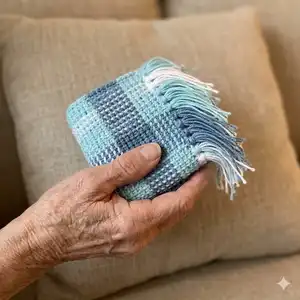
Make a soft, modern gingham blanket using DK weight yarn and textured front- and back-post stitches. You will learn FPdc and BPdc techniques plus a simple surface slip-stitch gingham overlay and tassel finishing. The pattern is written for a medium-size blanket and includes tables so you can easily change width and length to suit your needs.
Progress Tracker
0% Complete
— Materials :
Info :
5mm crochet hook. 7mm crochet hook. Yarn: Ouma Ralie Feels Like Cashmere DK from Kismet Yarns: 3 x 100g Frosty White (A), 4 x 100g Bubblegum Blue (B - light blue), 4 x 100g Beach House Blue (C - dark blue).
Info :
Finished Size: 33.7 inches x 38.4 inches (85.5cm x 97.5cm). Tension: 11 Front/Back Post-and-chain stitches and 14 rows = 4 x 4 inches / 10 x 10cm.
Info :
Stitches & Abbreviations: ch = chain. sl st = slip stitch. hdc = half double crochet. BPdc = Back Post double crochet. FPdc = Front Post double crochet. st/sts = stitch/stitches. ch3-tc = chain 3 turning chain. H = crochet hook. YOH = yarn over hook. rep = repeat. WS = Wrong Side. RS = Right Side.
— Table 1 (Starting Chains & Width) :
Info :
Number of Starting Chains 142 = 69 FPdc after Row 2 = 7 Colour Panels = 66.5cm / 26.2 inches. 162 = 79 FPdc after Row 2 = 8 Colour Panels = 76cm / 29.9 inches. 182 = 89 FPdc after Row 2 = 9 Colour Panels = 85.5cm / 33.6 inches. 202 = 99 FPdc after Row 2 = 10 Colour Panels = 95cm / 37.4 inches. 222 = 109 FPdc after Row 2 = 11 Colour Panels = 104.5 / 41.1 inches. 242 = 119 FPdc after Row 2 = 12 Colour Panels = 114 / 44.9 inches.
— Table 2 (Total Rows & Length) :
Info :
Total number of rows 110 = 11 Colour Panels = 82.5cm / 32.5 inches. 120 = 12 Colour Panels = 90cm / 35.4 inches. 130 = 13 Colour Panels = 97.5cm / 38.4 inches. 140 = 14 Colour Panels = 105cm / 41.3 inches. 150 = 15 Colour Panels = 112.5cm / 44.3 inches. 160 = 16 Colour Panels = 120cm / 47.2 inches.
— Special Stitches & Techniques :
Info :
Surface crochet: Slip stitches are worked on the surface of the finished blanket to form the gingham pattern (photos 25-33).
Info :
Front Post and Back Post double crochet: These stitches are not made in the top of the previous row's stitches, but around the post of the indicated stitch. When made around the front of the post it is a front post stitch; when made around the back of the post it is a back post stitch.
Info :
Instructions for Front Post double crochet (FPdc): YOH (photo 2), insert H FROM THE FRONT towards the back, move the H behind the post of the indicated st and let the H come out in front again, YOH (photo 3), pull up a loop at the front of your work (3 loops on H), YOH (photo 4) and pull through 2 loops (photo 5), YOH and pull through last 2 loops (photo 6, 7-11).
Info :
Instructions for Back Post double crochet (BPdc): YOH (photo 14), insert H FROM THE BACK towards the front, move the H in front of the post of the indicated st (photo 15) and let the H come out in the back again, YOH, pull up a loop at the back of your work (3 loops on H), YOH (photo 16) and pull through 2 loops, YOH and pull through last 2 loops (photos 17-18).
— Instructions :
Info :
Instructions are written for a medium size blanket, consult Table 1 on page 3 for number of starting chains for smaller or bigger blanket sizes. This pattern tends to curl in the beginning, don’t worry when that happens, the surface crochet stitches added at the end will flatten it out.
Row 0 (Starting Chain) :
Ch 182 with colour A and 5mm H.
Row 1 :
hdc in fourth ch from H, ch 1, skip 1 st, *hdc in next st, ch 1, skip 1 st, rep from * to end of row, end with a hdc in last ch, turn (photo 1 shows the first few hdc's).
Row 2 :
(WS) ch 3, skip first st, *FPdc around next st, ch 1, rep from * to end of row, hdc around ch3-tc, turn (see photos 2-11 for FPdc, photos 12-13 for last hdc - you should now have 89 FPdc and one hdc at the end of your row).
Row 3 :
(RS) ch 3, skip first st, *BPdc around next st, ch 1, rep from * to end of row, hdc around ch3-tc, turn (see photos 14-18).
Row 4 :
(WS) ch 3, skip first st, *FPdc around next st, ch 1, rep from * to end of row, hdc around ch3-tc, turn.
Rows 5-10 :
rep rows 3-4 another 3 times.
Rows 11-20 :
Change to colour B (photos 20-21, do this in the last st of row 10), rep rows 3-4 five times.
Rows 21-30 :
Change to colour C, rep rows 3-4 five times.
Rows 31-40 :
Change to colour B, rep rows 3-4 five times.
Rows 41-50 :
Change to colour A, rep rows 3-4 five times.
Rows 51-60 :
Change to colour B, rep rows 3-4 five times.
Rows 61-70 :
Change to colour C, rep rows 3-4 five times.
Rows 71-80 :
Change to colour B, rep rows 3-4 five times.
Rows 81-90 :
Change to colour A, rep rows 3-4 five times.
Rows 91-100 :
Change to colour B, rep rows 3-4 five times.
Rows 101-110 :
Change to colour C, rep rows 3-4 five times.
Rows 111-120 :
Change to colour B, rep rows 3-4 five times.
Rows 121-130 :
Change to colour A, rep rows 3-4 five times. Fasten Off.
— Surface Crochet :
Info :
Turn the blanket so that the WS is facing you. The BPdc and FPdc form vertical rows (photo 22), while the RS has horizontal rows (photo 23). When the WS is facing you, these horizontal rows almost look like the rungs of a ladder behind the BPdc and FPdc vertical rows (photo 24). The surface slip stitches are worked around these "rungs" of the ladder, with the WS facing you.
Step 1 :
Make a slipknot with colour C and place it around the 7mm crochet hook (make sure you leave a long yarn tail, you are not going to work your yarn ends away, you can leave these tails in the tassels you are going to add).
Step 2 :
Join colour C with a slip stitch on the right side of the first "vertical row" formed by the BPdc and FPdc, around the first bottom horizontal row (photo 25-26). Make sure that your working yarn is BEHIND the blanket.
Step 3 :
Make a slip stitch around the next horizontal row right above the bottom row. Keep making slip stitches around the horizontal rows (photo 27) until you reach the top and fasten off (remember to leave a long yarn tail, photo 32 = wrong side, photo 33 = right side).
Step 4 :
Begin the second vertical row by making slip stitches between the next two rows of BPdc and FPdc (remember to keep your working yarn BEHIND the blanket). Fasten off.
Step 5 :
Make 10 such slip stitch-rows in colour C. Continue making 10 slip stitch rows in each colour (see photo 28-31 for first row in colour B), following the same colour sequence: First with C, then B, A, B, C, B, A, B, C.
— Finishing :
Info :
Use your hook to pull the yarn tail of every second row into the adjacent space, where you will add your tassel (photo 34). Make 20 tassels of each colour and tie five at the bottom and five at the top of each of the vertical slip stitch columns in the same colour as the vertical slip stitches (one tassel every second row).
Step :
Use your hook to pull the mid-section of your tassel through the same space as your 2 yarn tails (photo 35), open it a bit wide with your fingers and pull the tail end of the tassel through (photo 36). Once you've added all the tassels, trim them to an even length.
This gingham blanket pattern is designed to give you a beautiful woven-look throw using crochet techniques that are fun to master. Whether you make it in the original blues or choose your own palette, the FPdc/BPdc texture plus surface slip stitch overlay will create a striking gingham effect. Enjoy the relaxing rhythm of these stitch combinations and finish with playful tassels for a cozy, handmade statement. 🧶✨