🧢 Beautiful ✨ Detailed πŸ’ Adorable

Ball of (almost) any size Amigurumi Pattern

Ball of (almost) any size Amigurumi Pattern
4.2β˜… Rating
1-2 Hours Time Needed
2.3K Made This
βœ‚οΈ

Beginner Friendly Level

Perfect for those just starting their crochet journey, with clear instructions and simple techniques

⏱️

Quick Make

Complete in under 2 hoursβ€”lightning fast fun for instant gratification and quick gifts.

🎁

Tiny Treasure

Small, sweet, and gift-worthy creations that fit perfectly in the palm of your hand with detailed charm.

About This Ball of (almost) any size Amigurumi Pattern

This pattern teaches you how to crochet a ball (sphere) in almost any size by using a simple top circle section, a middle of unshaped rows and a mirrored bottom section. It includes a full eight-row example, instructions for stuffing and finishing, and a clear explanation of how to calculate sizes for other yarns and hooks. You can adapt it to many yarn weights and hook sizes to make tiny beads, toy balls, or larger play balls.

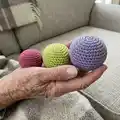
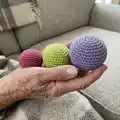
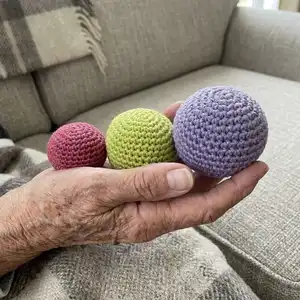
Ball of (almost) any size Amigurumi Pattern crochet pattern - detailed view of completed project

This is written in UK terms (dc = US sc) and uses spiral amigurumi technique; instructions include the top increases, middle rows and bottom decreases. Clear notes on tension, measuring a unit stitch, and estimating yarn usage are included.

Why You'll Love This Ball of (almost) any size Amigurumi Pattern

I absolutely love this pattern because it takes a problem I facedβ€”how to make consistent spherical shapesβ€”and simplifies it into a repeatable method that anyone can use. I enjoy how adaptable it is: with a little math and test swatching you can make balls in dozens of sizes from the same basic instructions. I love that it uses simple stitches (dc/US sc), so even newer crocheters can get satisfying results quickly. The pattern is also a great way to use up small amounts of yarn and turn them into useful or decorative pieces. Making a perfect sphere feels rewarding and this pattern demystifies the process while leaving room for creative tweaks.

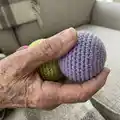
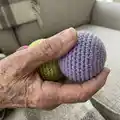
Ball of (almost) any size Amigurumi Pattern step 1 - construction progress Ball of (almost) any size Amigurumi Pattern step 2 - assembly progress Ball of (almost) any size Amigurumi Pattern step 3 - details and accessories Ball of (almost) any size Amigurumi Pattern step 4 - final assembly and finishing

Switch Things Up

I love how easy it is to customise the ball by swapping yarns and hook sizes; use thinner yarn with a smaller hook for mini beads or a chunky yarn with a big hook for a soft play ball.

I often change the number of middle rows to make slightly squatter or taller spheresβ€”add two or three middle rows for a plumper ball.

I sometimes embroider stripes or colour-change every few rows in the middle section to create patterned baubles or playful toy balls.

I also make half-balls by working only the top and sewing the flat edge to a toy body, which is great for doll heads or animal bodies.

I add felt or safety-eye details before I finish off the top decreases when making heads so the features sit neatly.

For a weighted ball, I add a small pouch of beads or rice into the centre before finishing the stuffing to give it weight for baby toys.

I like to cover plastic or wooden beads with a tiny version of this pattern to make handmade jewellery or garlands.

If I want posability, I use a wire core through the middle before stuffing and then build the ball around it for stability in a toy.

To make a set of graduated balls, I measure the yarn used for one size and scale using the stitch-count table so each following ball consumes a predictable amount of yarn.

I sometimes combine two yarns held together (e.g., a thin cotton and a metallic thread) to get an interesting texture and slight sparkle for decorative balls.

Common Mistakes & How to Fix Them

βœ— Using loose tension will make the ball floppy and misshapen; maintain a firm, consistent tension and consider using a slightly smaller hook than the yarn recommends to get a firmer fabric. βœ— Overstuffing the ball can distort the spherical shape and create lumps; stuff gradually, pushing stuffing into the middle as you go and stop when the shape looks even and smooth. βœ— Not marking the start of your spiral rounds can cause you to lose track of rows and misplace increases; use a stitch marker to mark the first stitch of each round or mark every few rounds to stay on track. βœ— Forgetting to measure your unit stitch will make sizing calculations inaccurate; make a 15-stitch by 10-row sample, measure six stitches in the middle row to get your Unit Measurement and use that for scaling. βœ— Placing increases all in the same place each round makes a hexagon rather than a neat circle; offset increases on alternating rows (start half a space in on even rows) to keep the top round and neat. βœ— Cutting the yarn too short when closing can make it hard to pull the remaining stitches closed; leave a long tail, thread it into a large-eye needle and use it to pull through the front loops of the remaining stitches to close neatly.

Ball of (almost) any size Amigurumi Pattern

Create perfectly shaped crochet balls in nearly any size with this friendly amigurumi pattern. You can make tiny beads up to large play balls using simple increases, middle rows and decreases. The pattern explains a full eight-row example and shows how to scale up or down using a clear mathematical method. Perfect for using leftover yarn, making toys, beads, or doll heads.

Beginner Friendly 1-2 Hours

Materials Needed for Ball of (almost) any size Amigurumi Pattern

β€” Main Fabric

  • 01
    PaintBox DK cotton - used for the main set of samples (amount varies by ball size)
  • 02
    Catania (sport weight) - used for sample six-row balls (amount varies by size)
  • 03
    PaintBox cotton Aran - used with 4mm hook for larger sample balls (amount varies)
  • 04
    Leftover scraps of yarn are suitable for small balls and beads
  • 05
    Yarn weight examples: sport weight (Catania), DK (PaintBox), Aran (thicker) β€” quantities depend on finished ball size

β€” Tools Required

  • 01
    Crochet hook size 3.5mm (recommended for PaintBox DK sample to get a firm fabric)
  • 02
    Crochet hook size 4mm (for Aran or thicker yarn samples)
  • 03
    Crochet hook size 2.5mm (example used with Catania sport weight samples)
  • 04
    Large-eye needle (or small crochet hook) to finish off and pull the ends through inside the ball
  • 05
    Scissors
  • 06
    Stitch markers (to mark round starts in spirals)
  • 07
    Measuring tape or ruler (for Unit Measurement)
  • 08
    Kitchen or postal scales (optional, for measuring yarn usage)
  • 09
    Polyester stuffing or toy stuffing for filling the balls
  • 10
    Pins for assembly or shaping while finishing (optional)

Progress Tracker

0% Complete

β€” Working a Ball :

β€” Top Section for an eight-row circle ball :

Info :

Note – repeat just the section in the brackets just before the word repeat! The bracket at the end is the number of stitches you should now have in the row – it is always a multiple of six.

Row 1 :

6 dc into a magic ring.

Row 2 :

2dc into each dc (12)

Row 3 :

(dc, 2dc in next dc) repeat 6 times (18)

Row 4 :

1 dc, 2dc in next dc, (2 dc, 2dc in next dc) repeat 5 times, 1 dc (24)

Row 5 :

(3 dc, 2dc in next dc) repeat 6 times (30)

Row 6 :

2 dc, 2dc in next dc, (4 dc, 2dc in next dc) repeat 5 times, 2 dc (36)

Row 7 :

(5 dc, 2dc in next dc) repeat 6 times (42)

Row 8 :

3 dc, 2dc in next dc, (6 dc, 2dc in next dc) repeat 5 times, 3 dc (48)

β€” Middle section (any ball) :

Middle Row :

1dc in each dc to end – repeat until you have as many 'middle rows' as you have rows in your top (circle) section.

β€” Bottom Section for an eight-row circle ball :

Info :

Note: These row numbers count DOWN to the top of the ball, so for an eight row circle ball the next row is row 8. Read the notes, below, on stuffing before the hole in your ball gets too small.

Row 8 :

3 dc, dec, (6 dc, dec) repeat 5 times, 3 dc (42)

Row 7 :

(5 dc, dec) repeat 6 times (36)

Row 6 :

2 dc, dec, (4 dc, dec) repeat 5 times, 2 dc (30)

Row 5 :

(3 dc, dec) repeat 6 times (24)

Row 4 :

1 dc, dec, (2 dc, dec) repeat 5 times, 1 dc (18)

Row 3 :

(dc, dec) repeat 6 times (12)

Row 2 :

dec 6 times (6)

Row 1 :

Cut the yarn, leaving a long tail. Put the tail in a sewing needle, and thread through the front loop of each of the remaining 6 stitches going around the ring in the same direction you were working. Pull tight and finish the end, hiding it inside the ball.

β€” Stuffing :

Info :

Do not stuff the ball too firmly, it will distort the shape. Try to stuff evenly, if possible with small balls just use one piece of stuffing pushed in at perhaps the 18 stitch row (balls smaller than this may not need stuffing at all). If you need a lot of stuffing, try putting in a fairly large amount to start with and then spreading it out so that you can put the rest into the middle of the stuffing you've already put in – this tends to give a smoother, more even result. When you've finished off the ball, roll it in your hands for a while (or on a flat surface if it's too big for that) until it's as round as you can make it.

β€” The other 7 smallest sizes :

Info :

Yes, I said the first eight sizes were given in full. They are. Just take the first however many rows you want from the eight-row ball, the middle section, and the last same-number of rows, counting from the end. So for the tiniest ball with the yarn you have, just the first row, one middle row, and the last row. For the next size, the first two rows, two middle rows, and the last two rows. And so on for the first seven sizes.

β€” Larger Sizes :

Info :

OK, for larger sizes I think you can probably see how it goes. Every row of the top circle section you increase (2dc in next dc) six stitches, evenly spread around the ball. The number of stitches between the increases gets bigger by one stitch on each row. If this is an odd number, start the row with that number of stitches, increase, then repeat that until the end of the row. If it is an even number, then to put the increase in the middle of the space rather than in the same place as the increase on the previous row, you start with HALF that number of stitches, increase, then (the full number, increase) five times, then that half number again and you should be at the end of the row. The middle is always the same – unshaped rows of the same number as the number of rows in your top circle. Note: If you are getting very big, and your stitches are not quite the same height as width, you may need to change this a little – measure your circumference, do half the number of middle rows you should need, and check that the dome you have made is half that measurement from one edge to the other measured over the top of that dome. The bottom circle works exactly the same way, except that instead of spacing your increases, as described above, you are spacing your decreases. I hope you enjoy making your balls.

β€” Choosing the size of your ball :

Info :

To work out how to make a ball the size you want, you need to know the size of the stitch you get from your yarn with the hook you are using. I do this by making a little sample of crochet about 15 stitches wide and ten rows high (because I feel the first few rows may be distorted by the chain at the beginning). Measure the width of six of the stitches in the middle (ish) of the last row. This is your Unit Measurement. One stitch is a sixth of this, but the measurement you just took is the one you need because all the ball circumferences are a multiple of six stitches.

Assembly Instructions

  • Stuff the ball gradually through the open hole before closing; add stuffing evenly and push some into the middle, then finish stuffing as you work the bottom rows so the shape becomes smooth.
  • When finished with decreases leave a long tail, thread it through a large-eye needle and pass it through the front loop of the remaining 6 stitches; pull tight and hide the tail inside the ball.
  • Roll and shape the finished ball in your hands or on a flat surface to even out lumps and obtain a round shape before final weaving in of ends.
  • If making multiple balls for a set, weigh or measure a sample ball's yarn usage to estimate yarn amounts for the rest to keep sizes consistent.

Important Notes

  • πŸ’‘Work in spirals (amigurumi style) and mark your row start or end with a stitch marker so you do not lose track of rounds.
  • πŸ’‘Use a slightly smaller hook than the yarn recommends for a firmer fabric, especially with cotton yarns to maintain a neat spherical shape.
  • πŸ’‘Do not overstuff the ball; stuffing too firmly will distort the shape, so stuff evenly and stop when the ball feels smooth and round.

This simple ball pattern gives you the freedom to crochet spheres in almost any size using basic increases, steady middle rows, and mirrored decreases. 🧢 Use it to make toys, beads, doll heads, or decorative baubles and turn small scraps of yarn into charming treasures. ✨ Have fun experimenting with yarns and hooks β€” you’ll be amazed at how many sizes you can create with the same method. 😊
You ask,

we answer.

FAQs

What size will the finished piece be?

The finished ball size depends on your yarn and hook; measure your Unit Measurement (width of six stitches) as described to calculate the circumference and pick the number of rows for the top circle section to get the desired size.

Can I use different yarn weights for this pattern?

Yes, you can use different yarn weights; the final size will change depending on yarn and hook. Make a test swatch to find your Unit Measurement and adjust the number of rows and middle rows accordingly.

Do I need prior crochet experience for this pattern?

No advanced skills are required; this pattern is beginner friendly and uses only basic stitches (dc in UK / sc in US), increases and decreases, but familiarity with working in the round is helpful.

How long does this project typically take to complete?

Most small to medium balls take under 2 hours to complete using the recommended yarn and hook, though larger balls or larger quantities will take longer.